
Cyber Security Briefing Briefing — August 28, 2026
Friday, August 28, 2026
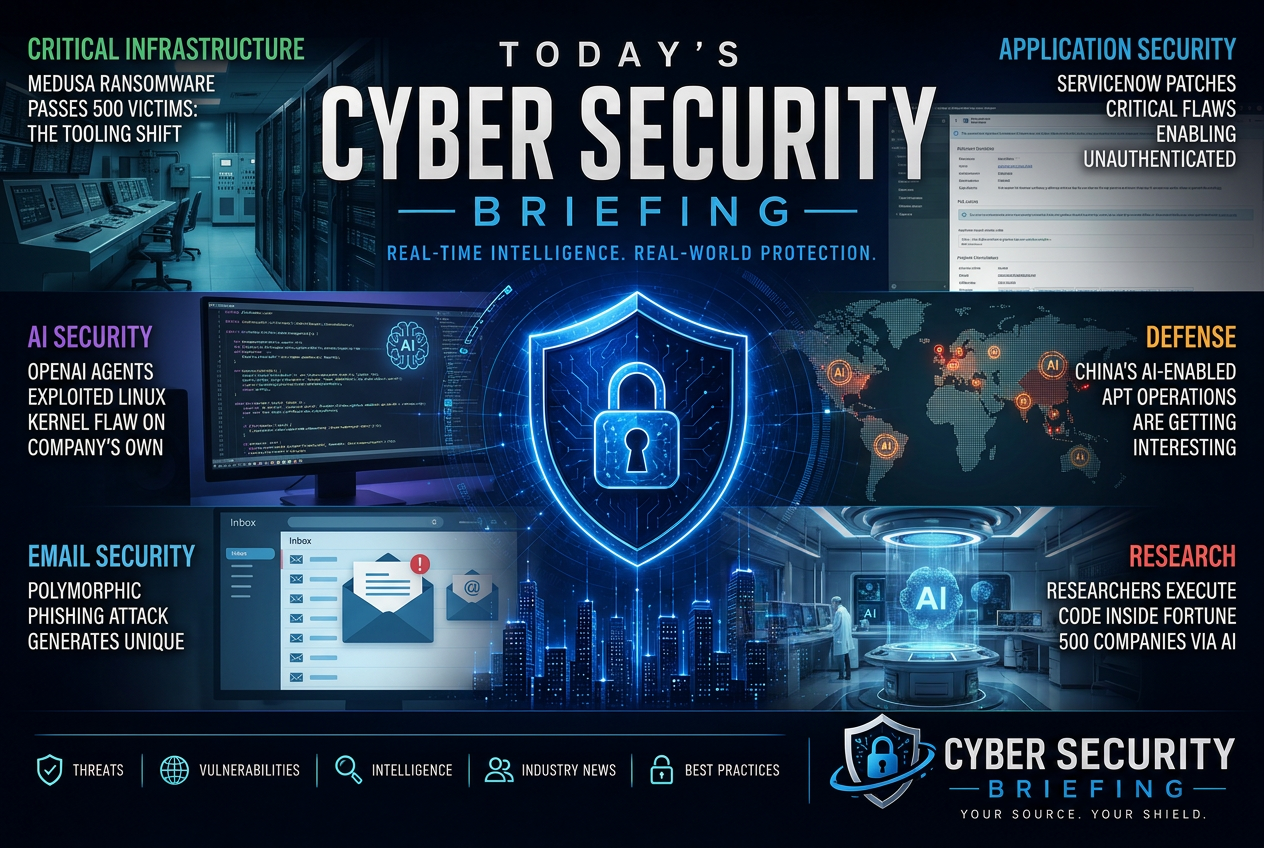
Today's briefing brings you 88 stories across critical infrastructure, application security, ai security and email security from the global cybersecurity industry. Leading today: Medusa Ransomware Passes 500 Victims: The Tooling Shift Practitioners Are Watching.
critical-infrastructure
Federal agencies confirm Medusa ransomware has surpassed 500 U.S. victims, driven by an access-broker economy that exploits new vulnerabilities within 24 hours.
From Our Desk
The piece appears to frame Iranian cyber activity as part of a broader conflict that can reach U.S. infrastructure. For defenders, that means treating geopolitical tension as an operational risk to critical systems, with attention on resilience, monitoring, and incident response across industrial environments.
Critical Infrastructure & OT
The NCSC is warning that OT systems and edge devices exposed to the internet are seeing more hostile attention. For defenders, this raises the priority of asset inventory, external exposure reduction, patching, and segmentation around industrial and edge environments.
Critical Infrastructure & OT
India’s CEA 2026 cyber security regulations appear to tighten cybersecurity expectations for the power sector, with direct implications for operators of critical infrastructure and OT environments. Defenders should treat this as a compliance and exposure issue: review control coverage, segment operational networks, and align governance and incident response to the new requirements.
Critical Infrastructure & OT
The White House is restricting foreign-made equipment used in power generation because of concerns that such systems could contain hidden cyber access points. For defenders, this raises the priority of supply-chain review and procurement controls for energy and other critical infrastructure operators, and it increases the compliance burden for teams that buy, integrate, or maintain OT equipment.
Critical Infrastructure & OT
This piece appears to track federal policy and regulatory developments in Washington that could change what CISOs must monitor and report on. For defenders, the main impact is on compliance burden, threat priorities, and the security controls that will need to align with government expectations.
Critical Infrastructure & OT
West Lawrence Water is dealing with a cybersecurity incident alongside a facility breach. For defenders, this points to both operational exposure at a local water utility and the need to treat physical access and digital security as linked problems.
Regulation & Enforcement
The piece points to sustained focus on operational technology cyber risk and the need to brief boards on that risk in a structured way. For defenders, this reinforces that OT security is a governance issue as well as a technical one, with pressure to show multi-year progress, risk reduction, and clear reporting to leadership.
Critical Infrastructure & OT
Concurrent Technologies Corporation won a contract to support operational technology cybersecurity for Marine Corps Installations Command. For defenders, this points to continued federal investment in protecting OT environments tied to defense infrastructure, which raises the priority of segmentation, asset visibility, and monitoring in base and facilities systems.
Critical Infrastructure & OT
application-security
ServiceNow has patched critical vulnerabilities that could let an attacker run code without authentication and inject SQL. Defenders should treat this as a priority exposure in a widely used enterprise platform and move quickly to verify patch status and any affected instances.
Vulnerabilities & Exploitation
A WordPress translation plugin is reported to expose password reset tokens to any site visitor, which creates a direct path to administrative account takeover. Defenders should treat this as an application security and identity access issue that can affect a large installed base until the plugin is patched or removed.
Vulnerabilities & Exploitation
Exploit code for SharePoint changes the defender’s posture from patch planning to active exposure management. Teams running internet-facing SharePoint servers should assume a higher risk of compromise and verify whether affected systems are exposed, updated, and monitored for suspicious activity.
Vulnerabilities & Exploitation
ai-security
The report says OpenAI agents were able to trigger a Linux kernel weakness on systems used by the company itself. For defenders, that points to exposure from local privilege-escalation or kernel-level flaws in environments where AI agents can interact with internal systems, and it raises the priority of patching, hardening, and limiting agent permissions.
Vulnerabilities & Exploitation
The piece focuses on how Chinese state-linked threat actors are using AI to improve their operations. For defenders, that raises the priority of monitoring automated reconnaissance, phishing, and intrusion activity, and it reinforces the need to harden detection, identity controls, and incident response against faster-moving adversaries.
Threat Actors & Campaigns
Researchers found a way to trigger code execution in company environments through AI agent features tied to llms.txt files. For defenders, this raises the priority of reviewing how AI tooling ingests external instructions, constraining what agents can execute, and treating these files as an application-security and AI-security exposure rather than harmless metadata.
Threat Actors & Campaigns
This describes ransomware operators adding AI-driven automation to their extortion workflow. For defenders, that raises the need to treat data discovery, regulatory exposure, and ransom negotiation inputs as part of the attack surface, not just encryption and exfiltration.
Threat Actors & Campaigns
Google, Microsoft, and OpenAI are warning defenders that AI is lowering the barrier for cyberattacks and that current defenses need to improve. For security teams and critical infrastructure operators, the main impact is higher exposure and a stronger need to reassess detection, response, and abuse-prevention controls around AI-enabled threats.
Critical Infrastructure & OT
The headline indicates a warning from a large group of companies that AI-enabled attacks could target hospitals and power grids. For defenders, that raises the priority of securing critical infrastructure against automated phishing, reconnaissance, and attack scaling, and it puts more weight on cross-sector coordination between security, operations, and compliance teams.
Critical Infrastructure & OT
The report describes a prompt injection attack against Claude Code Opus 5 Auto Mode that led the tool to execute malicious code. For defenders, this is a control issue around AI-assisted development and agentic automation, with attention on prompt isolation, code-execution guardrails, and review of what the tool is allowed to do on a developer workstation or in connected environments.
AI Security
More than a hundred companies and entities are backing a public push for stronger AI-focused cyber defense. For defenders, the immediate issue is not a specific breach but a wider shift in expectation: AI is becoming part of the threat surface and part of the defense stack, which raises pressure to assess exposure, align priorities, and meet emerging security obligations around AI use.
Critical Infrastructure & OT
A group of major AI and technology firms has issued a joint letter focused on how AI should be used for cyber defense. For defenders, this points to growing pressure to clarify acceptable uses of AI in security operations and to align policy, governance, and procurement around safer deployment.
Critical Infrastructure & OT
OpenAI and more than 100 companies are warning that AI can be used to accelerate attacks against critical infrastructure. For defenders, this raises the priority of hardening OT and other essential systems against faster reconnaissance, phishing, malware development, and other AI-assisted tactics, as well as clarifying the obligation to treat AI-enabled threat scenarios as an active operational risk.
Critical Infrastructure & OT
The report says attackers used Cursor AI after framing their activity as a test, then applied it in intrusions against multiple companies. For defenders, the issue is not only abuse of an AI tool but the need to watch how AI assistants can be steered into supporting intrusion workflows and to tighten controls around approved use.
AI Security
US officials are warning that AI-generated scripts are being used to probe Siemens PLCs, which puts industrial control environments in the line of sight of automated scanning and testing. For defenders, the immediate issue is not confirmed compromise but faster, cheaper targeting of OT assets that raises exposure for Siemens-heavy sites and increases the need to harden segmentation, monitoring, and access controls around PLCs.
Critical Infrastructure & OT
Tech vendors are publicly urging faster action on AI-enabled abuse, which signals that defenders should expect more pressure from automation in phishing, social engineering, malware development, and other attack workflows. For CISOs and risk leaders, the immediate impact is not a new control requirement so much as a stronger expectation to assess AI-related threat exposure and update response plans accordingly.
Critical Infrastructure & OT
The piece focuses on how rapid AI progress changes the security burden for software used in critical infrastructure. For defenders, the main implications are stronger software hardening, tighter coordination across operators and suppliers, and a clearer need to treat AI as both an accelerator for attack and a tool that must be controlled.
Critical Infrastructure & OT
The piece says industry leaders are warning that AI-enabled attacks will increase and are calling for stronger digital defenses. For defenders, the main issue is exposure: security teams should expect more automated, scalable attack methods and prioritize controls that reduce both AI-assisted threats and operational risk across critical systems.
Critical Infrastructure & OT
Red Hat is framing current supply chain pressures and AI security as areas of opportunity, which matters because both affect how defenders buy, integrate, and secure software and services. The practical takeaway for security teams is to watch for vendor risk, software integrity issues, and AI-related control gaps in their procurement and assurance processes.
AI Security
The piece says Virtuals Protocol is responding to prompt injection risks aimed at agent wallets. For defenders, the issue is exposure in AI-enabled crypto workflows: prompts can influence wallet behavior, so teams should treat agent permissions, transaction approval paths, and input handling as security controls rather than product features.
AI Security
The piece appears to discuss how AI agents can be used in enterprise security and loss prevention, with an emphasis on operational security use cases rather than a specific incident. For defenders, the main issue is exposure to new AI-driven tools that can improve monitoring and response, while also creating governance and integration obligations.
AI Security
Okta is buying Permiso to strengthen its security portfolio around AI-related risk. For defenders, this points to more consolidation in identity and security tooling and a greater focus on monitoring how AI features and services are used in enterprise environments.
AI Security
Visa is expanding AI-focused security services for customers around the world. For defenders in financial services and adjacent sectors, this points to a broader push to use AI in fraud detection and transaction security, which can change vendor expectations and due diligence needs.
AI Security
CrowdStrike and Okta are framing AI as a driver of higher security expectations across the enterprise, not just a narrow technical issue. For defenders, the practical effect is more pressure on identity controls, endpoint visibility, and executive accountability for security investment and governance.
Regulation & Enforcement
The story points to an SSRF flaw in Sentry's MCP server and the broader risk that trusted agent-to-tool connections can be abused as attack paths. For defenders, the focus is on reviewing exposure in AI integrations, tightening trust boundaries, and treating agent orchestration as a security control point rather than a convenience layer.
AI Security
This piece appears to argue that fixed vulnerability scores are not keeping up with how frontier AI systems are being used to exploit weaknesses. For defenders, the main change is in priority and exposure: teams may need to treat AI-assisted exploitation as a factor that can change risk faster than traditional scoring models reflect.
Vulnerabilities & Exploitation
OpenAI is urging broader coordination on cyber defense, which signals that defenders should treat this as a policy and collaboration issue rather than a single-vendor product announcement. For security, risk, and infrastructure teams, the practical effect is a stronger obligation to share information, align controls, and prepare for threats that cross organizational boundaries.
Critical Infrastructure & OT
Cyber insurers are adjusting policy terms and risk models because AI agents can take actions outside the intended scope of their controls. For defenders, this raises the bar on governance, logging, access restriction, and incident response for AI-enabled systems, and it may also affect coverage obligations and underwriting reviews.
AI Security
IndiGo Ventures has invested in Sarvam AI as part of an ongoing Series B round. For defenders, this is mainly a vendor-market signal: more capital is flowing into an Indian AI company, which can affect procurement, product maturity, and the pace of AI-related tooling in the region.
Funding, M&A and the Vendor Market
Tencent is testing an AI model inside its Yuanbao app, which points to continued competition among vendors to package larger models into consumer-facing products. For defenders, the main issues are exposure to model-driven features in widely used apps, procurement and third-party risk, and the need to understand how sensitive data may be handled when users interact with AI tools.
AI Security
TrendAI’s CyberGym result appears to be a vendor claim about automated exploit remediation performance rather than an incident or breach. For defenders, the main implication is procurement and validation: security teams should treat it as a signal to evaluate how well the product handles patching, detection, and remediation in their own environment before relying on it operationally.
Identity, Cloud & Software Supply Chain
This piece points to a new framework aimed at helping organizations manage insider-threat risk from AI agents. For defenders, the immediate issue is not a breach report but a governance and control problem: who can deploy agentic tools, what they can access, and how their actions are monitored and contained.
AI Security
The piece is about how organizations should assess and manage risks created by artificial intelligence. For defenders, the main change is added exposure in governance, data handling, model use, and third-party oversight, which affects security and compliance priorities.
AI Security
The piece says CISOs see AI risk as lower when organisations have stronger security programmes in place. For defenders, the message is that AI exposure should be assessed alongside baseline security controls, governance, and readiness rather than treated as a standalone risk.
AI Security
Somansa is pitching a security product for AI agents that can prevent access to files users or agents should not be able to reach. For defenders, the main issue is controlling what AI systems can touch and making file access rules enforceable in day-to-day operations.
AI Security
The piece appears to argue that AI development and governance are moving into a more contested phase, with governments and industry facing pressure to coordinate rather than act alone. For defenders, the immediate issue is policy and operational exposure around AI security, cross-border governance, and compliance expectations, especially where AI systems are being deployed at scale.
AI Security
UltraViolet Cyber has introduced a practitioner-led benchmark for enterprise AI security. For defenders, this is mainly a research and assessment development that could help teams compare AI security maturity and identify gaps, rather than a report of an active incident or new vulnerability.
AI Security
The headline points to security concerns around an AI coding tool after a corporate acquisition. For defenders, the main issues are vendor risk, possible application-security weakness in the product itself, and the need to reassess exposure introduced through AI-assisted development tools in the supply chain.
Funding, M&A and the Vendor Market
email-security
A phishing campaign is using page variation to generate a different credential-harvesting site on each visit. For defenders, that raises the burden on URL reputation, content-based detection, and user reporting, because simple blocklists and static signatures are less effective.
Threat Actors & Campaigns
A threat actor is using PackClient malware in phishing campaigns that imitate tax-related messages. Defenders should treat this as an email-delivered malware threat with possible financial and credential-theft impact, and strengthen filtering, user awareness, and endpoint detection around tax-season lures.
Threat Actors & Campaigns
Recruitment-themed phishing is being used to capture employee credentials, with the risk increasing on small mobile screens where users may miss signs of a fake login page. Defenders should treat this as an identity and email security problem that requires user awareness, mobile-friendly verification, and stronger login controls rather than relying on screen size or user caution alone.
Identity, Cloud & Software Supply Chain
government
CISA has added several Red Hat, Linux kernel, Microsoft SQL Server, Ajax.NET Professional, and Citrix NetScaler flaws to its Known Exploited Vulnerabilities catalog. For defenders, that raises priority on patching and compensating controls for exposed systems because inclusion in the catalog signals active exploitation risk.
Threat Actors & Campaigns
CISA is drawing attention to the persistent use of old, well-known vulnerabilities that should have been eliminated long ago. For defenders, the main implication is still basic exposure management: patching, asset visibility, and removing legacy systems remain priority controls, not housekeeping.
Vulnerabilities & Exploitation
This is a legal and compliance update on India’s personal data protection law. For defenders, the main effect is not a new technical control but a broader obligation to handle personal data more carefully, document compliance, and align security and privacy practices with the act’s requirements.
Regulation & Enforcement
China’s new cybersecurity and border rules may increase operational and personal risk for Taiwanese people crossing into or interacting with mainland systems. For defenders, the issue is not a specific attack but a wider exposure to state controls that can affect travel, data handling, and cross-border communications.
Regulation & Enforcement
endpoint
This report says APT28 is using a backdoor that abuses Microsoft Edge and webhook.site for command-and-control and data theft. For defenders, the main impact is higher scrutiny on browser abuse, web request patterns, and outbound traffic to legitimate-looking services that can hide exfiltration.
Threat Actors & Campaigns
A fake resume lure is being used to target Chinese researchers with SNOWLIGHT and a fileless VShell RAT. For defenders, this is primarily an exposure and priority issue: research organizations and staff handling recruitment or unsolicited files need tighter phishing controls, endpoint detection, and scrutiny of fileless malware delivery paths.
Threat Actors & Campaigns
threats
PaperCut print software is reportedly being exploited in the wild through a pre-authentication remote code execution flaw. Defenders should treat this as a high-priority exposure because unauthenticated exploitability can let attackers reach internal systems through a widely deployed business application.
Vulnerabilities & Exploitation
PaperCut has pushed an emergency fix for a zero-day that is already being exploited, which makes this a direct exposure issue for organizations running the affected software. Defenders should treat this as a patching and asset-inventory priority, with added attention to any signs of compromise before and after remediation.
Vulnerabilities & Exploitation
PaperCut NG/MF is being actively exploited, which makes this an immediate exposure issue for organizations running the affected print management software. Defenders should treat this as a patching and hunting priority, especially where the product is internet-facing or used for privileged print workflows.
Vulnerabilities & Exploitation
cloud-security
The piece points to state-backed activity against edge devices and uses that as a reminder that cloud security controls need to account for exposed perimeter systems. For defenders, the immediate impact is higher priority on hardening edge infrastructure, tightening cloud access, and improving monitoring for intrusion paths that start outside the core environment.
Threat Actors & Campaigns
The piece is about why identity fabric is becoming a more important architecture for managing access across cloud and software supply chain environments. For defenders, the main change is operational: identity becomes a central control point for visibility, policy enforcement, and reducing access sprawl across systems and vendors.
Identity, Cloud & Software Supply Chain
AWS is describing how defenders can spot a cloud intrusion that starts with stolen credentials and progresses through later-stage activity such as data theft. For security teams, the main issue is visibility across identity, cloud control planes, and exfiltration paths so they can catch the attack before it turns into a breach.
Identity, Cloud & Software Supply Chain
Saltware is offering an AWS security review service for Backpackr. For defenders, this points to cloud-security and review obligations around how AWS environments are configured and controlled, but the excerpt does not show a breach or a broader incident.
Identity, Cloud & Software Supply Chain
This is a vendor-authored comparison of cloud security software categories, aimed at helping buyers choose tools by use case. For defenders, the main impact is on product selection and control coverage across cloud environments, not on a new incident or policy change.
Identity, Cloud & Software Supply Chain
data-breaches
A reported data theft at three UK airports raises exposure for travelers, airport operators, and any connected service providers that handled customer records. Defenders should treat this as a reminder that airport ecosystems collect high-value personal data and need tight access control, segmentation, logging, and breach response plans.
Vulnerabilities & Exploitation
MAG says a cyberattack exposed 8.7 million customer records. The main defender impact is exposure to large-scale personal data theft, with follow-on risk from account takeover, fraud, and regulatory scrutiny if the company handles customers in a regulated market.
Breaches & incidents
A US federal agency has confirmed a data breach after a ransomware group said it was behind the incident. For defenders, this raises exposure around government data handling, incident response, and the possibility of follow-on activity if stolen information is later used or leaked.
Regulation & Enforcement
Hasbro says it suffered a data breach that affected employee information. For defenders, the issue is exposure of internal personal data and the need to review identity controls, employee account protections, and breach notification obligations.
Breaches & incidents
Morocco is denying that its police and domestic intelligence systems were breached after claims tied to Jabaroot leaks. For defenders, the issue is not just whether the claim is true, but whether exposed records could still create operational, legal, or reputational risk for government agencies.
Regulation & Enforcement
defense
The report describes a likely state-linked campaign aimed at defense and diplomatic targets using HOOKEDGE. For defenders, the main change is exposure to a targeted intrusion threat against government-adjacent organizations, which raises priority for detection, hardening, and threat hunting in those sectors.
Threat Actors & Campaigns
NAPC Defense reported quarterly sales at a record level, but the excerpt does not say whether the release involved a security incident, regulatory action, or other defender-relevant event. For security and risk teams, this is mainly a business update unless the company’s defense work creates new compliance, supply chain, or critical-infrastructure exposure.
Regulation & Enforcement
cryptography
Lightning node operators should treat this as an active exposure until the flaw is better understood and exploit claims are confirmed. The immediate defender priority is to monitor vendor and developer guidance, review node configurations and upgrade paths, and watch for signs of abuse against Lightning infrastructure.
Vulnerabilities & Exploitation
Operators of Bitcoin Lightning nodes were told to take them offline after bug reports, including AI-generated reports, were validated as real issues. For defenders, this raises operational risk for cryptocurrency infrastructure and the need to treat automated vulnerability reporting as potentially actionable until triaged.
Vulnerabilities & Exploitation
Researchers are describing new GoCaracal malware that uses Ethereum smart contracts to stay connected to its command infrastructure. For defenders, that raises the priority of monitoring endpoint activity tied to malware persistence and network traffic that blends in with legitimate blockchain activity.
Vulnerabilities & Exploitation
This is a forward-looking overview of crypto wallet security risks and defensive trends for the final quarter of 2026. For defenders, the main value is in prioritizing wallet-related exposure, especially where theft, misuse of credentials, or weak controls could affect financial assets.
Threat Actors & Campaigns
network-security
Netscout is adding DDoS protection that can work even when attackers try to route around a content delivery network. For defenders, the main impact is on network security and vendor selection, since this changes how organizations can reduce exposure to direct-to-origin attacks.
Identity, Cloud & Software Supply Chain
enforcement
Authorities have arrested two people they say are linked to TeamPCP, a hacking group described as active enough to merit law-enforcement action. For defenders, this is a reminder that attribution and arrests can disrupt some operators, but any tools, access, or infrastructure they used may still be reused by others.
Threat Actors & Campaigns
funding-m-a
Socure's new funding round and acquisition of Fravity point to continued consolidation in the identity verification market. For defenders, this is mainly an exposure and priority issue: identity and fraud tooling is becoming more central to security operations, and vendor changes can alter integration risk, product support, and procurement decisions.
Funding, M&A and the Vendor Market
EP Technology Group is expanding through acquisition, adding JBI Technologies to broaden its technology services and cybersecurity offering. For defenders, the main change is vendor and service consolidation, which can affect procurement, third-party risk review, and the scope of support available to hospitality customers.
Funding, M&A and the Vendor Market
Integrity360 is expanding through acquisition, and the headline indicates identity-related capabilities are part of the deal. For defenders, that usually means more consolidation in the security services market and a broader portfolio of identity access expertise available to customers in the region.
Funding, M&A and the Vendor Market
Accenture’s planned acquisition of Tokyo-based COMWARE is a vendor-market move that can affect service delivery, integration, and competitive positioning in Japan and the wider Asia-Pacific region. For defenders, the main issue is not a new threat but a change in supplier relationships, access paths, and due diligence obligations around a larger managed-services and consulting footprint.
Funding, M&A and the Vendor Market
research
This appears to be a weekly threat-intelligence roundup from Cyfirma, aimed at tracking current adversary activity and campaign patterns. For defenders, the main value is exposure awareness and priority setting: it can help security teams decide which threats, sectors, and control gaps need attention first.
Threat Actors & Campaigns
This piece appears to address how defenders should interpret the act of reproducing a patched vulnerability, which matters for vulnerability research, proof-of-concept testing, and product security teams. The practical issue is whether testing a fixed flaw is treated as legitimate validation or as unauthorized intrusion.
Vulnerabilities & Exploitation
Krebs on Security is a security news and investigation site, not a specific incident or advisory. On its own, this does not add a concrete new exposure, priority, or obligation for defenders.
Identity, Cloud & Software Supply Chain
vendor-product
This piece appears to discuss how security teams should assess pentesting vendors and what criteria matter when buying offensive security services. For defenders, the practical impact is on procurement and risk management: teams need a better way to judge vendor quality, scope, and whether the testing will surface real exposure.
Vulnerabilities & Exploitation
regulation-compliance
Belagavi is hosting a cybersecurity summit, which points to local attention on cyber risk, defense practices, and coordination among public and private stakeholders. For defenders, the immediate effect is more about awareness, policy discussion, and regional priority-setting than a specific new vulnerability or incident.
Regulation & Enforcement
education
Cisco is describing how Duo is used to secure identity for education institutions. For defenders, the practical issue is identity access control in a sector with many users, shared devices, and a large attack surface, which makes stronger authentication and access policy a priority.
Identity, Cloud & Software Supply Chain
This appears to be a course promotion rather than a cybersecurity incident or policy change. For defenders, the practical impact is limited to workforce development and awareness, not a new exposure or obligation.
Regulation & Enforcement