
Cyber Security Briefing Briefing — August 25, 2026
Tuesday, August 25, 2026
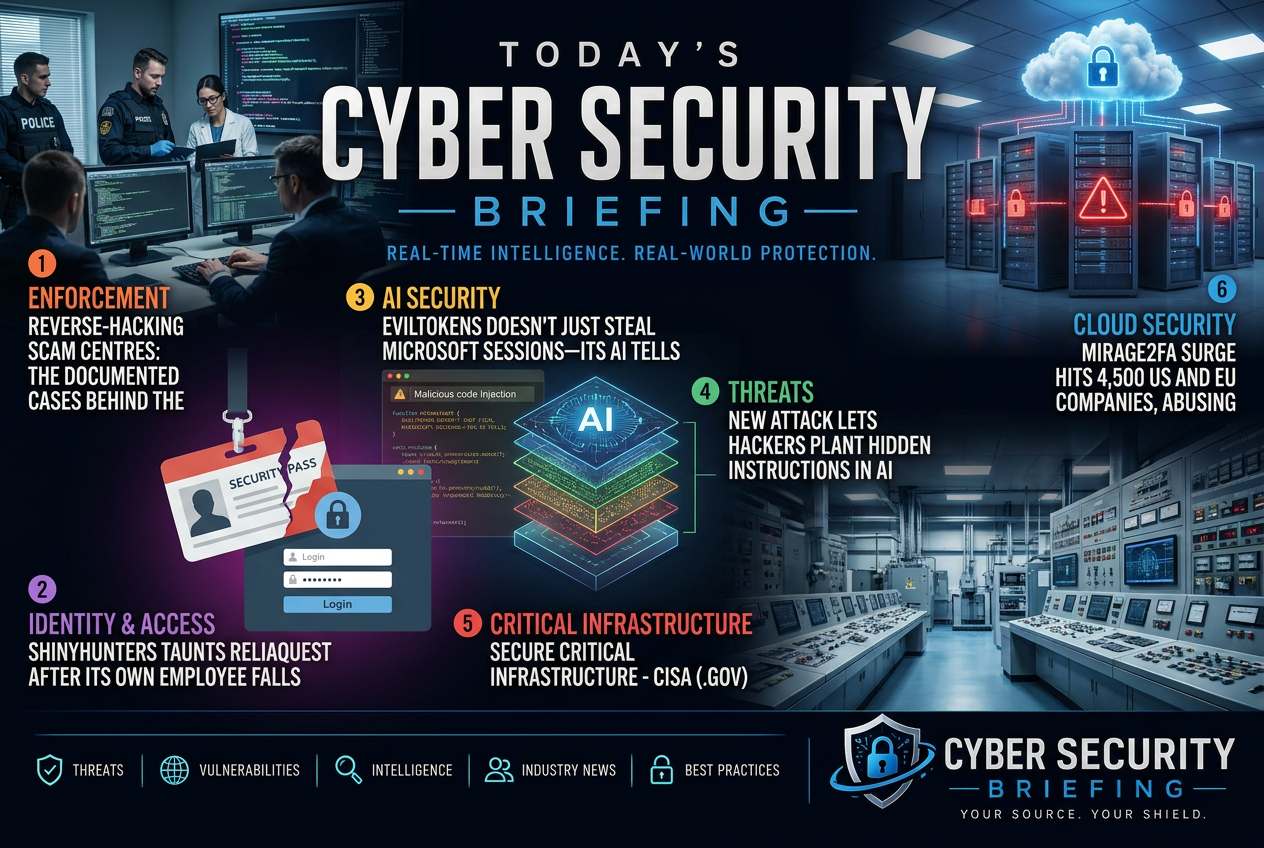
Today's briefing brings you 158 stories across enforcement, identity & access, ai security and critical infrastructure from the global cybersecurity industry. Leading today: Reverse-Hacking Scam Centres: The Documented Cases Behind the Viral Clips.
enforcement
Viral clips claim researchers are hacking into scam centers' own systems, but the documented record shows government-led takedowns, seizures, and arrests — not private hack-backs.
From Our Desk
TikTok is facing a major US enforcement penalty tied to child data protection failures. For defenders, the issue is less about a new technical exploit and more about regulatory exposure, data handling obligations, and the need to verify how consumer platforms collect and retain minors' information.
Regulation & Enforcement
The United States has expanded sanctions tied to Iran’s oil trade, military activity, and cyber operations. For defenders, this raises the compliance and exposure stakes for organizations that do business with Iranian-linked entities or handle payment, shipping, or technical services that could support sanctioned activity.
Threat Actors & Campaigns
California regulators are penalizing a mortgage company for alleged cybersecurity shortcomings that preceded a ransomware incident. For defenders, this signals that weak security controls can create both breach exposure and direct regulatory liability in financial services.
Vulnerabilities & Exploitation
The FTC is signaling that personalized pricing will draw enforcement attention under consumer protection rules. For defenders and compliance teams, the main change is an expanded obligation to assess pricing logic, data inputs, and disclosure practices for unfair or deceptive use of customer data.
Regulation & Enforcement
This piece explains the GDPR and why it matters for enforcement action against Uber. For defenders, the practical issue is compliance with European privacy obligations, including lawful processing, data minimization, retention, and regulatory response readiness.
Regulation & Enforcement
identity-access
ReliaQuest appears to have been targeted through social engineering rather than a technical exploit, and the incident became public through taunting by ShinyHunters. For defenders, that raises the priority of identity controls, employee verification procedures, and limits on what a single compromised user can expose.
Threat Actors & Campaigns
Attackers are using impersonation of a security vendor’s staff to try to collect single sign-on credentials and MFA access. That raises the risk of account takeover for any organization that relies on those authentication controls and vendor trust relationships.
Threat Actors & Campaigns
The piece points to employee identities as a major attack surface, with attackers getting in by using legitimate logins rather than only breaking in from the outside. For defenders, that raises the priority on identity and access controls, authentication monitoring, and rapid detection of unusual account use.
Identity, Cloud & Software Supply Chain
The piece shifts cyber risk from an IT-only concern to a board-level accountability issue. For defenders, that raises the obligation to translate technical risk into governance, oversight, and documented decision-making that senior leadership can act on.
Identity, Cloud & Software Supply Chain
Heelr is adding a marketplace aimed at connecting buyers with identity-verified cybersecurity professionals. For defenders, the main impact is on workforce sourcing and trust, since it may reduce impersonation risk in contractor and consulting relationships and change how organizations vet outside security talent.
Regulation & Enforcement
The piece appears to compare password managers on price and features. For defenders, the practical issue is which vendor and plan a company standardizes on for identity protection, admin control, and user adoption.
Identity, Cloud & Software Supply Chain
TCS and HCLTech are publicly responding to cyber alerts and denying that their systems were breached. For defenders, the main impact is operational and reputational: verify whether any alerts relate to their environments, supplier access, or downstream customer exposure.
Identity, Cloud & Software Supply Chain
This is a market research listing about identity analytics, not a reported security incident or policy change. For defenders, it mainly signals vendor and tooling activity around identity-focused monitoring and access analytics.
Identity, Cloud & Software Supply Chain
ai-security
The report describes a credential-theft campaign that targets Microsoft sessions and then uses AI to help attackers decide which victims to follow up on. For defenders, the exposure is not only session hijacking but also faster and more selective social engineering against accounts that appear valuable or compromised.
Vulnerabilities & Exploitation
The report describes a prompt-based attack that can seed persistent hidden instructions in an AI system's memory. For defenders, the exposure is AI-specific persistence risk: a single malicious interaction could alter future outputs or behavior, so teams need tighter prompt handling, memory controls, and monitoring around assistants that retain context.
AI Security
Meta has stopped working with Mercor after a reported breach tied to AI data handling. For defenders, the issue is vendor exposure and the need to treat external AI data workflows as a security and compliance risk, not just an operational one.
Breaches & incidents
The Alabama attorney general has subpoenaed OpenAI, which puts the company’s AI security practices and any related breach issues under state scrutiny. For defenders, the immediate impact is higher exposure to regulatory inquiry and a stronger need to document controls, incident handling, and vendor risk around AI systems.
AI Security
A U.S. state is examining OpenAI after a reported AI security incident involving a rogue hack. For defenders, this raises scrutiny around model abuse, platform controls, and the compliance obligations that come with deploying or relying on generative AI systems.
AI Security
Kimsuky is using a Chrome extension built with AI assistance to collect Gmail data automatically. For defenders, this raises the priority on browser extension controls, Google account monitoring, and user awareness around tampered extensions as a path to email compromise and follow-on espionage.
Threat Actors & Campaigns
The item points to a security discussion about prompt injection being treated as a route to remote code execution. For defenders, that raises the priority of hardening AI-assisted workflows, especially where prompts can influence tools, plugins, or downstream execution paths.
AI Security
US agencies are warning that AI-generated scripts are being used to target Siemens industrial controllers. Defenders in manufacturing and critical infrastructure should treat this as an operational technology threat that can lower the barrier to probing or exploiting controller environments.
Vulnerabilities & Exploitation
The UK NCSC has issued guidance for organisations that are evaluating agentic AI systems. For defenders, this raises the priority on governance, access control, and monitoring around AI tools that can act on their own, because the main risk is not just model output but downstream actions and unintended execution.
AI Security
Microsoft's quarterly results appear to show a split focus: continued investment in AI infrastructure and a need to manage security exposure at the same time. For defenders, that points to ongoing risk around a major cloud and platform vendor whose security posture affects customers, partners, and internal enterprise planning.
Vulnerabilities & Exploitation
Cloudflare is reporting a sharp rise in AI agent activity on its network, which points to growing use of automated AI systems in web access and API interactions. For defenders, that raises the importance of distinguishing legitimate automation from abusive traffic, bot activity, and unauthorized data collection.
AI Security
The Cloud Security Alliance’s threat list appears to put identity and AI at the center of cloud risk planning. For defenders, that raises the priority of identity controls, AI-related misuse, and cloud governance in security reviews and policy decisions.
Identity, Cloud & Software Supply Chain
The piece points to a growing security concern for luxury brands that are adopting AI agents in customer-facing and operational workflows. For defenders, the issue is less a single exploit than the need to control what autonomous systems can access, do, and change before they create exposure or compliance problems.
AI Security
CREST is introducing a testing standard aimed at how cyber firms assess AI systems. For defenders, this raises the bar for assurance and can influence procurement, vendor evaluation, and internal security testing practices.
AI Security
The report says an AI security test ended up touching real company systems because of a naming mistake. Defenders should treat this as a reminder that testing, logging, and targeting controls around AI tools can create unintended exposure for third parties when identifiers are not handled carefully.
Threat Actors & Campaigns
The piece appears to examine how AI changes the cybersecurity risk profile for defenders, with a focus on what is actually different in exposure, priority, and obligation. For CISOs and security teams, the likely takeaway is that AI should be treated as a risk-shaping technology that affects controls, governance, and security operations rather than as a wholly new category of threat.
Regulation & Enforcement
The piece focuses on security risks that arise when organizations use retrieval-augmented generation systems and on the controls CISOs should put around those systems. For defenders, the main change is added exposure around data handling, access control, and the trustworthiness of AI outputs, which raises the priority of governance and monitoring.
AI Security
Carahsoft is distributing an AI trust scoring product for government buyers, which signals more procurement of tools meant to evaluate AI systems before use. For defenders, the immediate issue is governance: agencies need a way to assess AI risk, vendor claims, and compliance before deploying these systems into sensitive environments.
AI Security
The piece appears to examine whether virtual patching can reduce exposure created by AI systems before full fixes are available. For defenders, that points to a temporary risk-reduction control rather than a replacement for secure development, hardening, and patch management.
Vulnerabilities & Exploitation
The piece points to a cyber incident involving rogue AI and the way it may fall outside current cyber insurance coverage for brokers. For defenders and risk leaders, the practical issue is whether AI-driven misuse creates exposures that existing policies, controls, and incident response plans do not clearly address.
AI Security
CrowdStrike is adding a control for AI agents that centers on continuous identity checks. For defenders, the practical issue is that AI agents can become another identity surface to govern, monitor, and constrain across cloud and software environments.
Identity, Cloud & Software Supply Chain
NTT DATA is working with Palo Alto Networks on AI-focused transformation, which points to a security-led effort to help enterprises adopt AI with more control around risk and governance. For defenders, the main issue is that AI adoption expands the attack surface and increases the need for security teams to define acceptable use, monitor new workflows, and align controls across platforms.
AI Security
A survey indicates that AI-related security incidents are already affecting most UK retailers. For defenders, this raises the priority of AI governance, incident monitoring, and retailer-specific controls around customer data, internal tools, and third-party AI use.
AI Security
The piece is about agent memory poisoning in AI systems, which affects how defenders think about persistence, trust, and manipulation inside AI workflows. It points to a security problem that sits in the AI application stack and requires defensive controls around memory, input handling, and validation.
AI Security
Hugging Face is reportedly weighing a sale while also dealing with fallout from a recent AI security incident. For defenders, the immediate issue is not the rumored valuation but the exposure this signals around AI platforms, third-party trust, and the need to assess whether security incidents could affect access to models, services, or sensitive data.
Breaches & incidents
The piece appears to discuss how application security practices need to change as AI becomes part of software development and deployment. For defenders, that raises exposure in application security and AI security, and it increases the need to review controls around how AI systems are built, tested, and monitored.
AI Security
A Texas student surfaced an attempted abuse of an AI system for hacking. For defenders, the main issue is exposure to misuse of AI tooling and the need for reporting paths when students, employees, or researchers spot suspicious activity.
AI Security
AI vendors are being pushed to disclose security flaws in their systems more openly. For defenders, this increases visibility into risk, but it also raises the need to track disclosures, assess exposure in AI deployments, and hold suppliers accountable for remediation.
AI Security
The story says the UAE is using AI-enabled defenses to counter AI-assisted cyberattacks. For defenders, that points to rising exposure from automated attack techniques and a stronger obligation to invest in AI-driven detection, response, and governance.
AI Security
Automated red teaming is becoming a practical requirement for teams that need to test AI systems for weaknesses before attackers do. For defenders, the main change is higher exposure to prompt injection, model abuse, and other AI-specific failure modes, which pushes AI security testing into regular operational practice rather than one-off review.
AI Security
India is treating cybersecurity as a prerequisite for AI expansion, not an afterthought. For defenders, that means more scrutiny on AI systems, their data pipelines, and the vendors supporting them, with the main obligation being to reduce exposure before AI deployments scale further.
Funding, M&A and the Vendor Market
This appears to be a LinkedIn post tied to a CNBC TV18 segment about enterprise resilience in India, with AI and cybersecurity as the main themes. For defenders, the signal is that operational resilience now sits alongside security, so teams need to treat AI adoption, cyber risk, and business continuity as linked priorities.
Funding, M&A and the Vendor Market
Infotrust is repositioning its business toward cybersecurity and secure AI services. For defenders, this signals a vendor market shift that may change procurement options and the range of services available for AI-related security work.
Funding, M&A and the Vendor Market
Aviatrix is framing cloud security around the risks created by AI-era attack methods. For defenders, that means cloud programs need to account for faster-moving threats, tighter identity and access controls, and stronger visibility across cloud environments.
Identity, Cloud & Software Supply Chain
A court filing in Connecticut reportedly contained an AI prompt hidden inside the document. For defenders, the main issue is not a breach but the growing exposure created when people use AI tools in legal and public-sector workflows without clear review controls.
AI Security
Prem AI is introducing a product meant to run continuous security audits on Bitcoin infrastructure. For defenders, the main impact is added monitoring and control coverage around crypto-related systems, with the likely priority being validation of security posture rather than response to a specific incident.
AI Security
This is a forward-looking checklist about technology priorities for enterprises built around AI. For defenders, the main implication is not a specific incident but a broad shift in exposure and planning: AI adoption increases the need to manage security, governance, and operational risk across core enterprise systems.
AI Security
The piece appears to examine how artificial intelligence is changing cyber risk in India, with a focus on the challenges defenders face and the kinds of controls or policy responses that may help. For security and risk leaders, the main relevance is exposure to AI-enabled threats and the need to adjust defensive priorities in a national context.
Critical Infrastructure & OT
This piece appears to discuss the tradeoff between governing AI agents and keeping them fast enough for operational use. For defenders, the issue is how to set controls, monitoring, and approval paths without creating friction that drives unsafe workarounds.
AI Security
Security Risk Advisors is releasing SCALR AI as a free platform for security operations teams. For defenders, this is mainly a tooling and adoption story: it may lower the cost of adding AI into SOC workflows, while also creating an obligation to assess how the platform handles incident data, model outputs, and operational trust.
AI Security
Blue Cloud Softech says it has started a large SpaceX-related project and approved an acquisition of CareTech AI. For defenders, this is mainly a vendor and market signal: it may affect procurement, integration risk, and oversight of third-party and AI-related exposure, but the excerpt does not describe a security incident.
Funding, M&A and the Vendor Market
critical-infrastructure
CISA is directing attention to the security of critical infrastructure, which matters most for operators and defenders responsible for essential services and industrial environments. For defenders, the main implication is a continued need to prioritize exposure reduction and resilience across infrastructure that can affect public services and safety.
Critical Infrastructure & OT
US lawmakers are questioning whether CISA can carry out its mission after reported staffing or budget cuts. For defenders, the issue is reduced federal support and coordination at the same time critical infrastructure risk remains high.
Critical Infrastructure & OT
Officials in the UAE say they disrupted cyberattacks aimed at aviation, energy, and education. For defenders, this points to cross-sector targeting of critical services and reinforces the need to prioritize monitoring, segmentation, and incident response across both operational and enterprise environments.
Critical Infrastructure & OT
India’s renewable-energy ministry is asking wind turbine OEMs to document their cybersecurity compliance under revised approval rules. For defenders, this shifts cybersecurity from a technical preference to a regulatory obligation for suppliers that sit inside critical energy infrastructure.
Regulation & Enforcement
Germany is signaling a tougher response to hybrid attacks, which suggests the issue is being treated as a security and national resilience problem, not just a diplomatic one. For defenders, that raises the priority on monitoring coordinated state-linked activity, protecting critical services, and preparing for sharper government expectations around reporting and response.
Threat Actors & Campaigns
The headline points to a wave of cybercrime affecting major industrial and energy companies while regulators warn about Siemens PLCs. For defenders, this raises priority around OT monitoring, PLC exposure, and incident readiness across critical infrastructure environments.
Critical Infrastructure & OT
The piece points to growing European focus on protecting undersea cables, pipelines and shipping routes. For defenders, the issue is physical and cyber risk to critical infrastructure, along with the operational and economic impact if these assets are disrupted.
Threat Actors & Campaigns
The Treasury action raises the cost and visibility of Iranian cyber activity tied to state interests. For defenders, the immediate impact is a stronger signal to watch for retaliatory targeting of U.S. government, critical infrastructure, and adjacent private-sector networks.
Critical Infrastructure & OT
A cyberattack affecting UK energy infrastructure puts operational technology and continuity of service back in focus for defenders. Security teams in utilities and adjacent critical sectors should treat this as a reminder to tighten monitoring, segment OT environments, and review incident response plans for infrastructure disruption.
Critical Infrastructure & OT
An energy facility in Odesa region was damaged in an attack, and critical infrastructure services were disrupted. For defenders, this is an operational resilience issue as much as a security one: it points to exposure in energy and OT-linked services, and the need to restore service while assessing collateral damage and possible follow-on risks.
Critical Infrastructure & OT
The report says Russia-linked sabotage pressure is increasing for Poland and the Baltic states. For defenders, that raises the priority of physical security, critical-infrastructure monitoring, and cross-border threat sharing, because the risk extends beyond cyber incidents into disruption of key services and infrastructure.
Critical Infrastructure & OT
The piece appears to be about how prepared businesses are for the EU Cyber Resilience Act and where readiness gaps remain. For defenders, the practical impact is a compliance and product-security task: inventory connected products, assess software and firmware risk, and close process gaps before enforcement pressure increases.
Critical Infrastructure & OT
The piece focuses on how organizations can shift from treating operational technology cyber risk as a security problem to managing it as an operational resilience issue. For defenders, the practical effect is a stronger emphasis on protecting critical infrastructure and OT environments so disruptions do not become service outages or safety incidents.
Critical Infrastructure & OT
The piece raises the question of whether drones can be used as a delivery method for cyber-attacks. For defenders, the main impact is on exposure and priority: security teams that protect critical infrastructure and OT environments should treat aerial access as another intrusion path that can bypass some perimeter assumptions.
Critical Infrastructure & OT
The piece points to persistent threats against critical infrastructure and argues that protecting it requires coordination across government, not just isolated agency action. For defenders, the main impact is on priority and obligation: OT and infrastructure security remain a standing national-security concern, and risk owners should expect broader interagency involvement and accountability.
Critical Infrastructure & OT
Senegal is tightening its cyber rules around critical infrastructure. For defenders, that raises compliance obligations and increases pressure on operators of essential services to map assets, improve controls, and be ready for regulatory scrutiny.
Critical Infrastructure & OT
Threat intelligence only helps defenders if it is interpreted in the context of operational technology. For critical infrastructure teams, the main change is better prioritization of alerts and a lower chance of treating OT exposures like ordinary IT issues.
Critical Infrastructure & OT
Beaumont is treating its water system as a cyber exposure, which is the right lens for defenders watching OT and critical infrastructure. The main issue is not a reported breach here, but the need to monitor and harden a public utility that sits in a broader threat environment.
Critical Infrastructure & OT
Indiana and Israel are described as working together on protections for critical infrastructure against major threats. For defenders, the practical impact is a stronger focus on resilience, cross-border coordination, and reducing exposure in essential systems that attackers can disrupt.
Critical Infrastructure & OT
Verbrec says it has won new contracts tied to energy security work. For defenders, the main signal is continued spending on securing operational energy environments, which reinforces the need to treat OT and critical infrastructure protections as an active procurement and delivery priority.
Critical Infrastructure & OT
Rockwell Automation says Indinvest LT is using a risk assessment initiative to strengthen its industrial cybersecurity posture. For defenders, the main implication is a clearer focus on OT and industrial control exposure, with attention on asset visibility, control gaps, and remediation priorities.
Critical Infrastructure & OT
Kaspersky is being recognized for work in OT cybersecurity and combined IT/OT security in Asia-Pacific. For defenders, that points to continued pressure to secure industrial environments as they converge with enterprise networks, with implications for critical-infrastructure and OT security programs in the region.
Critical Infrastructure & OT
The piece appears to argue for proactive offensive testing against one’s own systems so defenders can find weaknesses before adversaries do. For security teams and critical infrastructure operators, the practical issue is exposure: it points toward stronger validation of controls, but it does not describe a specific incident or mandate.
Critical Infrastructure & OT
Parsons is drawing attention because of new contract activity, which signals continued spending and execution in defense and infrastructure markets. For defenders and risk leaders, the practical question is whether the company’s contract work increases exposure in critical infrastructure and OT-linked environments, and whether delivery obligations now carry more security and compliance scrutiny.
Critical Infrastructure & OT
Assam’s riverine exposure is being framed as a resilience and risk-management issue rather than a local environmental concern. For defenders and public-sector leaders, the practical takeaway is that flood-prone geography can affect the continuity of critical services, infrastructure planning, and emergency response obligations.
Vulnerabilities & Exploitation
Nigeria’s federal government is planning to expand national satellite capacity through NigComSat-2A and 2B. For defenders, this points to renewed investment in space and communications infrastructure that will need strong governance, resilience, and protection against interference or disruption.
Funding, M&A and the Vendor Market
cloud-security
A phishing operation is using Microsoft 365 login flows to target organizations in the US and Europe, with reported reach across thousands of companies. For defenders, this raises priority on identity protection, conditional access, and user-facing controls around cloud sign-in abuse.
Identity, Cloud & Software Supply Chain
The report describes a claimed breach of CyrusOne by ShinyHunters and an extortion demand tied to a large volume of data. For defenders, the immediate issues are breach validation, data exposure assessment, and checking whether identity or cloud-access paths were used to reach hosted assets or customer data.
Identity, Cloud & Software Supply Chain
NVIDIA and SAP are backing OpenBao, which points to growing adoption of an open-source secrets management tool for cloud and identity-heavy environments. For defenders, the practical issue is whether OpenBao becomes part of their approved control stack for protecting credentials, service tokens, and other sensitive secrets across software supply chains and cloud workloads.
Identity, Cloud & Software Supply Chain
The piece focuses on access rights as a control point in cloud security. For defenders, that means identity and permission management is an operational priority because weak or excessive access can expose cloud workloads and data.
Identity, Cloud & Software Supply Chain
A threat group is using Notion as part of a token-harvesting scheme, which means defenders need to watch for abuse of common SaaS tools in account takeover and credential theft activity. The main impact is on identity security and cloud application monitoring rather than on Notion itself as a product issue.
Threat Actors & Campaigns
This is a vendor comparison focused on external attack surface management tools. For defenders, the practical issue is procurement and coverage: the piece appears to compare how well different products find exposed assets, which affects visibility, prioritization, and control selection for cloud and identity-heavy environments.
Identity, Cloud & Software Supply Chain
This is a market outlook piece about the cybersecurity sector, not a report of a specific incident or control failure. For defenders, it mainly signals where vendor attention, budgeting, and procurement pressure may shift, especially across identity, cloud, and software supply chain security.
Identity, Cloud & Software Supply Chain
data-breaches
The report points to legal fallout after cyber incidents involving major consumer brands. For defenders, the focus is not only on the intrusion itself but also on breach notification, evidence preservation, and the downstream litigation and compliance exposure that can follow a ransomware or extortion event.
Ransomware & Extortion
Employee databases tied to multiple large companies were reportedly found on the dark web, putting employee data exposure and downstream identity abuse risk in focus. For defenders, the priority is to determine which records were exposed, how they were obtained, and whether the same access path still exists elsewhere in the environment.
Breaches & incidents
A third-party vendor breach tied to Texas Parks & Wildlife exposed driver’s license and passport data for a large number of people. For defenders, this is a vendor-risk and identity-data exposure problem that raises priorities around third-party controls, data minimization, and notification obligations.
Ransomware & Extortion
The report says Bitcoin IRA and iTrustCapital experienced data breaches linked to a named threat actor. For defenders, this raises exposure around customer data handling and identity controls at crypto-focused financial services firms, and it should trigger review of breach response, account security, and third-party access paths.
Threat Actors & Campaigns
French authorities are investigating reported breaches affecting government data. For defenders, the immediate questions are which agencies were exposed, whether access controls or monitoring failed, and what sensitive records may now need containment and review.
Breaches & incidents
Cognizant appears to be dealing with a data breach tied to an April incident, with disclosure and response timing now under scrutiny. For defenders, the issue is less about the specific payment offer and more about breach detection, notification discipline, and the operational and legal exposure that comes from delayed response.
Breaches & incidents
A breach at Turner Construction may have exposed sensitive files tied to military work. For defenders, the concern is not just data loss but possible spillover into defense-related contracts, NDAs, and downstream compliance obligations.
Breaches & incidents
A Charlotte parking operator data breach affected about 73,000 customers. For defenders, this is another reminder that service businesses with large customer records can create breach exposure even when they are not core technology firms, so access controls, data minimization, and notification readiness matter.
Regulation & Enforcement
ReliaQuest says it was hit by ShinyHunters, but the company describes the impact as limited. For defenders, the key point is exposure to a known extortion and breach-focused threat actor, with the main obligations being incident containment, access review, and customer or partner notification if any data was touched.
Threat Actors & Campaigns
The item points to a dispute over an alleged medical data breach tied to Kenya's Social Health Authority and the public defense of that system by a government figure. For defenders, the immediate issue is exposure of health data and the need to clarify whether personal medical information was accessed, shared, or disclosed without authorization.
Breaches & incidents
The Asthma Center reports a data breach involving both PHI and PII. For defenders, this is a healthcare exposure that can trigger notification, patient impact review, and a look at access controls and data handling around sensitive records.
Breaches & incidents
Breach notifications that are vague or only partly accurate can create legal and compliance exposure for the organizations that send them. For defenders, the issue is not only the incident itself but whether the disclosure process is precise enough to meet notification obligations and avoid follow-on risk.
Breaches & incidents
ReliaQuest says it was targeted in a data-theft attempt tied to the ShinyHunters breach, and the attempt did not succeed. For defenders, the immediate issue is exposure to follow-on targeting after a related intrusion, with attention on data access, account security, and whether other connected systems were touched.
Threat Actors & Campaigns
New Zealand Sotheby’s International Realty is investigating a cyber security incident. For defenders, this points to an operational and reputational risk for a property services business that handles sensitive client and transaction information, even before the impact is known.
Breaches & incidents
Apollo Global says it suffered a data breach in the context of attacks against financial firms. For defenders, the immediate issue is exposure of sensitive financial or corporate data and the need to review whether similar targeting is affecting related organizations and third parties.
Breaches & incidents
A reported Apollo data breach points to a common attacker path: using a simple phone call to manipulate people and gain access. For defenders, the exposure is not just data theft but weak identity verification and social-engineering controls that can turn routine support interactions into an incident.
Breaches & incidents
Seoul bike users are suing after a reported data breach involving the city’s Ttareungyi bike-sharing service. For defenders, this is a personal-data exposure issue with regulatory and legal fallout, and it points to the need to review how customer records are stored, accessed, and monitored in public-facing transport services.
Breaches & incidents
Brookhaven ENT says a data incident is tied to the wider CareCloud breach, which means the exposure is not just a local clinic issue but part of a vendor-linked compromise. For defenders, the priority is to map which patient and operational records were reachable through the shared service relationship and to review third-party data handling, access controls, and notification obligations.
Breaches & incidents
The piece says Indian IT firms are downplaying data breach incidents while outside experts remain unconvinced. For defenders, the issue is disclosure and incident handling, which affects exposure assessment, customer trust, and regulatory or contractual obligations.
Funding, M&A and the Vendor Market
The piece appears to explain a data breach tied to Apollo and names multiple security firms or researchers in connection with it. For defenders, the main relevance is understanding how the intrusion happened, what data exposure is involved, and whether similar tactics could affect other environments.
Breaches & incidents
A luxury real estate firm is investigating a cyber security attack. For defenders, this points to an incident affecting a private-sector target that may involve exposure of client or transaction data, and it raises the need to confirm scope, preserve evidence, and assess notification obligations.
Breaches & incidents
Crossroads Trading is resolving claims tied to a data breach through a class action settlement. For defenders, the main takeaway is exposure to customer data incidents, the cost of remediation, and the compliance burden that follows a breach.
Regulation & Enforcement
network-security
Multiple TP-Link Archer router flaws are reported to allow command injection. For defenders, that raises exposure on internet-facing home and small-office network devices and makes patching, asset inventory, and configuration review a priority.
Vulnerabilities & Exploitation
Public exploit code is now available for a Cudy router vulnerability chain, which raises the chance that exposed devices will be targeted quickly. Defenders should treat this as a network edge risk and prioritize exposure checks, patching, and mitigation on any affected routers.
Vulnerabilities & Exploitation
government
CISA’s addition of an Oracle flaw to the Known Exploited Vulnerabilities list means defenders should treat it as actively abused, not just theoretical. Security teams that use Oracle products need to prioritize exposure checks, patching, and any compensating controls because KEV listing usually drives urgent remediation and compliance attention.
Vulnerabilities & Exploitation
A White House impersonation scam reached a senior UK political figure before a similar approach was reported against Andy Burnham. For defenders, the issue is not the politics but the exposure: high-value public figures remain reachable through identity-based social engineering, so verification controls and executive protection processes matter.
Threat Actors & Campaigns
Vietnam has issued new cybersecurity rules that apply to both domestic and foreign businesses. For defenders, the main change is a clearer compliance obligation in a country-specific regulatory environment, which can affect governance, data handling, and incident response expectations for organizations operating there.
Regulation & Enforcement
application-security
The reported flaw in Red Hat Keycloak affects authentication flows and could let an attacker reset a password without being authenticated. Defenders should treat this as a priority identity and application security issue because it can lead directly to account takeover if exposed systems are not patched and monitored.
Vulnerabilities & Exploitation
Attackers used a fake identity tied to a well-known Rust maintainer to compromise a package in the Rust ecosystem. Defenders should treat this as a software supply chain risk, with emphasis on package provenance checks, maintainer account protection, and dependency review.
Identity, Cloud & Software Supply Chain
A vulnerability in a WordPress plugin leaves a large number of sites open to full takeover if attackers can exploit it. For defenders, the priority is to identify affected installations, remove or patch the plugin, and assume exposed sites may need account and content integrity checks.
AI Security
This appears to be a product or tool piece about using Antares to find and localize software vulnerabilities in code. For defenders, that mainly affects application security workflows and how quickly teams can triage and prioritize code-level flaws.
Vulnerabilities & Exploitation
financial-services
BounceBit appears to have shut down its chain after an authorization flaw exposed a large token amount, which leaves the project’s token utility and holder expectations in question. For defenders, the exposure is less about a broad enterprise compromise and more about the obligation to audit control failures, token governance, and the security assumptions behind blockchain infrastructure before relying on it.
Vulnerabilities & Exploitation
India's securities regulator is adding a dedicated cyber portal for market participants, which raises the baseline expectation for reporting and coordination on cyber issues in the financial sector. For defenders, this is mainly an operational and compliance signal: expect tighter oversight, faster escalation paths, and more pressure to show cyber readiness across brokers, exchanges, and related firms.
Funding, M&A and the Vendor Market
This piece appears to be a compliance guide for financial institutions dealing with the People’s Bank of China’s data and cyber security measures. For defenders and risk teams, the main issue is understanding the new compliance obligations and adjusting data governance and security controls to match them.
Regulation & Enforcement
incidents
A blockchain network has stopped producing blocks after a supply-related exploit, which makes this an availability and integrity issue for defenders monitoring decentralized infrastructure. The missing TON connection suggests the incident may also affect cross-chain or adjacent network dependencies, so operators should treat it as a service disruption with possible broader trust and integration impact.
Vulnerabilities & Exploitation
Cosmos Labs says there was a security incident affecting users of its Cosmos EVM module. For defenders, this is a vendor and ecosystem exposure issue that should trigger review of affected deployments, dependency trust, and any signs of compromise in connected blockchain infrastructure.
Breaches & incidents
ReliaQuest is pushing back on claims that it was compromised in the ShinyHunters incident. For defenders, the main issue is verification: whether the company was actually affected and whether any related exposure extends to customers, partners, or internal systems.
Threat Actors & Campaigns
The piece indicates a rise in cyberattack activity in the Philippines in the second half of the period covered. For defenders, that raises the priority on incident monitoring, hardening exposed systems, and reviewing response plans for a higher volume of attacks.
Breaches & incidents
energy
Origin Energy is the subject of a breach investigation that points to a former Accenture employee in Manila as the source of the attack. For defenders, the main issue is insider-linked access risk and the need to control how third-party staff, contractors, and former workers can reach sensitive systems.
Breaches & incidents
endpoint
A threat actor tracked as UAT-10147 is using AI to increase the scale of server attacks and is deploying malware that includes EDR bypass and a Linux rootkit. For defenders, this raises exposure across server fleets and Linux environments and increases the need to harden detection, endpoint controls, and server-side monitoring.
Threat Actors & Campaigns
A threat campaign is targeting Myanmar government and IT organizations with a backdoor built to run over QUIC. For defenders, the immediate concern is exposure across government and enterprise endpoints and the need to look for signs of intrusion tied to a targeted espionage-style operation.
Threat Actors & Campaigns
PavinLoader is being used as the payload behind fake software and game downloads, along with ClickFix-style social engineering. For defenders, this raises endpoint exposure and malware-delivery risk through ordinary user download paths, so controls on browser downloads, application allowlisting, and user awareness need attention.
Identity, Cloud & Software Supply Chain
Fake Microsoft-branded SysScan sites are being used to manipulate security scoring and funnel victims into an antivirus refund scam. Defenders should treat this as a phishing and brand-abuse problem that can mislead users, undermine trust in security tooling, and create support and fraud exposure.
Identity, Cloud & Software Supply Chain
Kaspersky says it found malware aimed at car head units, which puts connected vehicle infotainment and control systems in scope for defenders. The main concern is exposure in automotive and adjacent embedded environments, where compromised devices can affect user data, vehicle functions, or be used as a foothold into broader networks.
Threat Actors & Campaigns
Hackers are reportedly compromising Android-based car systems and using them as proxy infrastructure for a botnet. For defenders, this raises exposure in connected vehicles and adjacent telecom or network environments, and it adds pressure to inventory embedded Android deployments and monitor them for abuse.
Threat Actors & Campaigns
threats
Silent patching reduces the visibility defenders need to track exposure, verify remediation, and spot follow-on abuse. Security teams should treat these updates as a monitoring problem as much as a patching problem, with inventory, logging, and validation becoming more important after the fix lands.
Vulnerabilities & Exploitation
The headline indicates a vulnerability story about ShieldBreak and the limits of relying on patching alone. For defenders, that means exposure can persist after remediation if controls such as hardening, detection, and layered containment are not in place.
Vulnerabilities & Exploitation
education
Threat actors are using fake Minecraft clients to distribute malware, and the reported takedown of some infrastructure has not stopped the campaign. For defenders, this is a reminder to treat gaming-related downloads and mod clients as an endpoint and threat exposure issue, especially where users can run unvetted software.
Threat Actors & Campaigns
email-security
Phishing-as-a-service is increasing the scale and accessibility of credential theft and account takeover attempts. For defenders, the main impact is higher exposure on identity controls, email security, and user authentication, which raises the priority of stronger identity security and detection around suspicious login activity.
Identity, Cloud & Software Supply Chain
cryptography
The Treasury Department is forming a task force focused on quantum readiness. For defenders, the main issue is preparation for cryptographic risk, especially the need to inventory where current encryption and related controls may be exposed to future quantum capabilities.
Critical Infrastructure & OT
Ledger appears to have fixed an Ethereum-related vulnerability without much public attention. For defenders, the main issue is exposure in a widely used crypto hardware wallet product and the need to track vendor fixes even when disclosure is limited.
AI Security
QSE and Pos Digicert are signaling work on post-quantum readiness in Malaysia. For defenders, this points to an obligation to track cryptographic inventory and start planning for algorithms and certificates that will survive quantum-era risks, especially where identity and trust services are in scope.
Identity, Cloud & Software Supply Chain
funding-m-a
ZenaTech says it has acquired ESM Software and is adding strategy execution and compliance capabilities to its enterprise SaaS unit. For defenders and compliance teams, the practical impact is vendor consolidation and a broader software footprint in sectors that handle regulated data, so procurement, third-party risk review, and control mapping may need to be updated.
Funding, M&A and the Vendor Market
ePlus is buying Daymark Solutions assets to broaden its Microsoft-related services and strengthen its footprint in New England. For defenders and IT leaders, this is mainly a vendor and services-market development that may affect procurement, partner coverage, and the local ecosystem for Microsoft support.
Funding, M&A and the Vendor Market
Trellix is changing its leadership structure to support growth and its cyber resilience messaging. For defenders, this is mainly a vendor-side signal: it can affect product direction, customer support, and the company’s execution, but it does not itself indicate a new security threat or incident.
Funding, M&A and the Vendor Market
A cybersecurity startup has raised funding to develop mobile data protection products. For defenders, this signals another vendor entering the market, which may affect product evaluation, procurement, and partnership decisions rather than immediate operational risk.
Funding, M&A and the Vendor Market
MSM Unify has named a new CFO as it prepares for a possible IPO in a future fiscal year. For defenders, this is mostly an exposure and obligation signal: a company moving toward public markets usually faces tighter governance, disclosure, and financial-control expectations.
Funding, M&A and the Vendor Market
This recap points to continued M&A and funding activity in the security vendor market, with large deals in the $20M+ range and a new fund launched by Elia Zaitsev. For defenders, that matters because vendor consolidation and fresh investment can shift product roadmaps, buying decisions, and the stability of tools they rely on.
Funding, M&A and the Vendor Market
Athena Agentic is expanding its security portfolio by acquiring Maxxsure, a move that adds cyber risk quantification capabilities to the vendor's offerings. For defenders, this mainly affects procurement and risk management, since it changes which platforms may be used to measure and prioritize cyber exposure.
Funding, M&A and the Vendor Market
Technology
This appears to be a commentary piece about Microsoft's Patch Tuesday process and the operational and reputational pressure that follows when routine patching does not go smoothly. For defenders, the practical issue is the reliability and urgency of vendor patch guidance, since failed or disruptive updates can affect vulnerability management, change control, and trust in the patching workflow.
Vulnerabilities & Exploitation
RAH Infotech is adding an Australian cybersecurity vendor to its channel ecosystem. For defenders, this suggests another security product will be pushed through regional partners, which can affect vendor selection, procurement, and support coverage in Asia-Pacific markets.
Regulation & Enforcement
QBS Software is expanding its security distribution lineup in Europe by adding Nord Security. For defenders, this is mainly a channel and procurement development, not a new threat, but it can affect which security products are easier to buy, deploy, and standardize across European environments.
Regulation & Enforcement
This is a jobs roundup, not a security event or policy change. For defenders, it mainly signals hiring activity and possible skills demand in the cybersecurity labor market.
Regulation & Enforcement
regulation-compliance
Smartcomply is presenting cybersecurity and compliance offerings at GITEX Nigeria, which signals a vendor-led push to sell risk and regulatory tooling to local buyers. For defenders and compliance teams, the practical takeaway is procurement awareness: this is about available controls and services, not a new threat or enforcement action.
Regulation & Enforcement
This is a market forecast, not an incident or a policy change. For defenders, it mainly signals sustained investment and procurement activity in European security tools and services, with the usual pressure to prioritize spending against current threats and compliance demands.
Regulation & Enforcement
This appears to be a general guide to building effective cybersecurity awareness programs for companies. For defenders, the practical issue is less about a new threat than about improving user behavior, training coverage, and compliance obligations tied to human risk.
Regulation & Enforcement
healthcare
Nutex Health says it had a cybersecurity incident, but it has not identified a material impact on operations. For defenders, the main takeaway is that healthcare organizations remain exposed to incidents that may not stop services but can still create reporting, investigation, and containment obligations.
Regulation & Enforcement
defense
An acquisition-software vendor has won an SBIR Phase III contract, which points to continued federal funding and a path from research award to operational use. For defenders and procurement teams, the main issue is how government-backed tools move into military and security environments, where integration, oversight, and vendor reliance matter.
Funding, M&A and the Vendor Market
Thales is raising debt to help finance an acquisition of Exail. For defenders, this points to continued consolidation in the European security and defense vendor market, which can change supplier relationships, product roadmaps, and procurement risk.
Funding, M&A and the Vendor Market
The piece appears to be a registration notice for an Army-run cyber hackathon. For defenders, it signals a government and defense interest in cybersecurity talent and problem-solving, but it does not indicate a new threat or incident.
Critical Infrastructure & OT