
Cyber Security Briefing Briefing — August 26, 2026
Wednesday, August 26, 2026
Today's briefing brings you 95 stories across defense, critical infrastructure, government and incidents from the global cybersecurity industry. Leading today: US says Chinese cyber spies targeted hospitals, government agencies and the military - KQ2.
defense
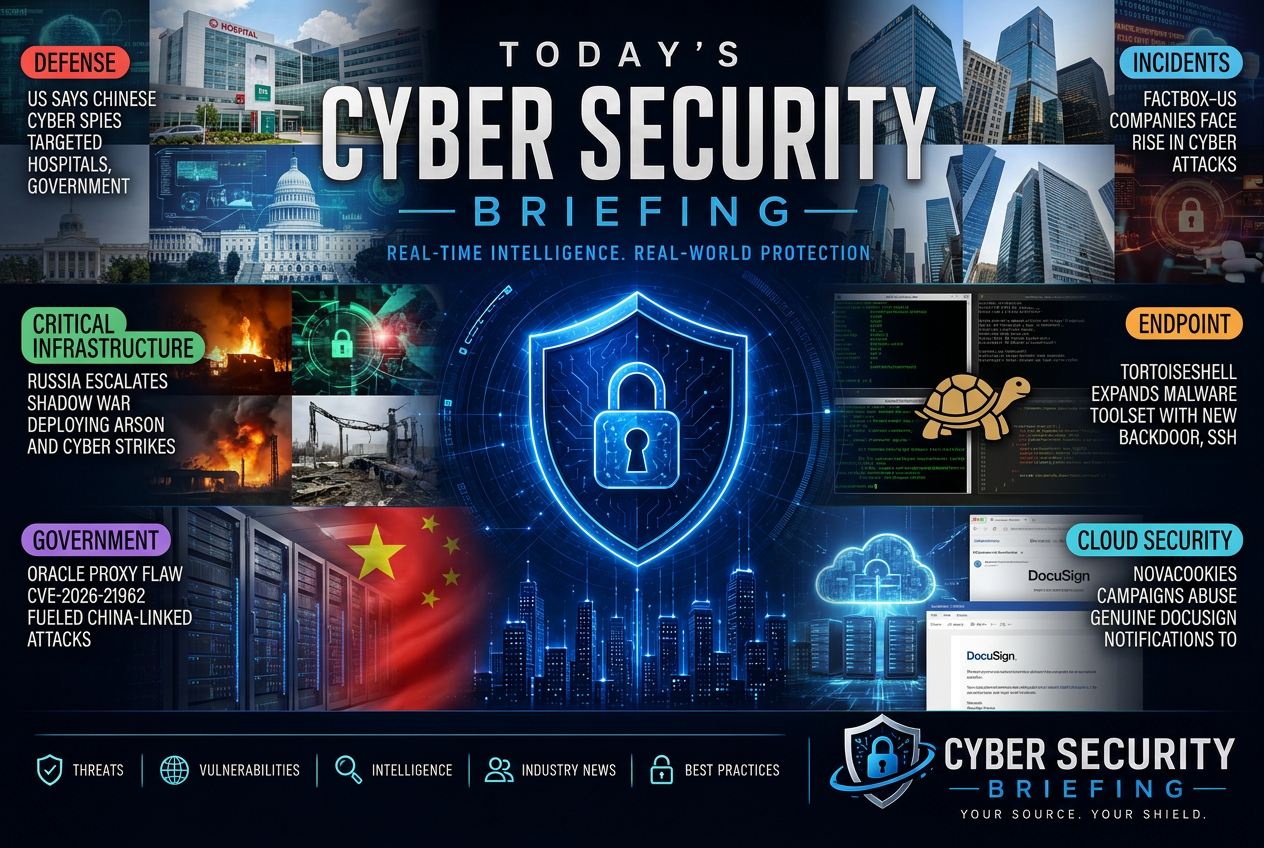
US officials are describing a Chinese cyber espionage campaign that reached into hospitals, government agencies and military targets. For defenders, this raises the priority on hardening identity controls, monitoring for intrusion activity, and reviewing incident response across healthcare and public-sector environments.
Threat Actors & Campaigns
German companies are seeing more cyber pressure from foreign intelligence services. For defenders, that points to espionage risk, stronger monitoring of targeted intrusion activity, and tighter controls around sensitive business and government-related data.
Threat Actors & Campaigns
critical-infrastructure
The report says Russia is using a mix of arson and cyber attacks to pressure European targets. For defenders, that raises the need to treat physical sabotage and digital intrusion as a linked threat set, especially for government, defense and critical infrastructure organizations in Europe.
Threat Actors & Campaigns
The FBI says it disrupted a proxy network used to support Chinese espionage activity. For defenders, the immediate issue is reduced exposure from this infrastructure, but it also shows that criminal or covert proxy services can be part of broader state-linked operations that may touch enterprise networks and critical infrastructure.
Critical Infrastructure & OT
The White House is preparing a program aimed at reducing hacking risk to water systems. For defenders, this signals added federal attention on critical infrastructure security, with likely pressure to harden OT environments and coordinate across public and private operators.
Critical Infrastructure & OT
The piece points to rising cyberattack risk around the energy sector in Australia. For defenders, that means higher exposure for critical infrastructure and a stronger need to prioritize OT and ICS protections, incident response readiness, and coordination between security and operations teams.
Critical Infrastructure & OT
The piece points to alleged Iranian activity directed at U.S. water infrastructure. For defenders, that raises the priority of monitoring OT and ICS environments, reviewing remote access paths, and coordinating between water utilities, local government, and federal partners.
Critical Infrastructure & OT
Kaspersky’s ICS CERT is reporting more ransomware activity against industrial control systems in the second quarter of 2026. For defenders, that points to higher operational risk for OT environments and a need to tighten segmentation, recovery planning, and monitoring around critical infrastructure.
Critical Infrastructure & OT
CypherGenics has launched a security product aimed at preparing systems for the post-quantum era. For defenders in critical infrastructure and OT environments, the practical question is whether this is a product announcement or a sign that cryptographic migration is becoming a near-term planning item.
Critical Infrastructure & OT
NIST is publishing cybersecurity guidance for building automation and control systems, which are part of the operational technology used to run facilities. For defenders, this raises the priority on securing building management environments that are often treated as separate from core IT but can still create exposure for critical infrastructure and enterprise sites.
Critical Infrastructure & OT
London rail safety authorities are requiring emergency systems that can keep operations safe when digital networks fail. For defenders, this raises the bar on resilience planning, failover design, and oversight of transport systems that depend on connected infrastructure.
Vulnerabilities & Exploitation
Linux reaching 35 years underscores how deeply open-source software is embedded in critical infrastructure and OT environments. For defenders, the practical issue is exposure: the security, patching, and support posture of Linux-based systems can affect reliability across sectors that depend on it.
Critical Infrastructure & OT
Mexico’s new cybersecurity plan signals a move from policy ambition to more structured national defense planning. For defenders, the practical question is whether the plan leads to clearer obligations, stronger coordination, and better protection for government and critical infrastructure targets.
Threat Actors & Campaigns
India is planning to end imports of SCADA systems after 2030, which points to a push for domestic control over operational technology used in critical infrastructure. For defenders, the immediate issue is supply chain and procurement risk: local content is still low, so buyers will need to validate product security, supportability, and migration plans well before the cutoff.
Critical Infrastructure & OT
The headline points to a local infrastructure security issue in Roanoke, but the excerpt does not provide enough detail to identify the threat, affected systems, or whether this is a reported incident or a broader risk assessment. For defenders, the main takeaway is that local digital infrastructure is part of the attack surface and should be reviewed as a municipal and regional resilience concern.
Threat Actors & Campaigns
The piece appears to argue that common communications standards are important for making critical infrastructure networks both secure and able to work across different systems. For defenders, the practical issue is not a new threat but a standards and interoperability problem that affects procurement, architecture, and compliance decisions.
Critical Infrastructure & OT
government
Oracle Proxy Flaw CVE-2026-21962 appears to have been used in attacks tied to China-linked activity against government targets. Defenders should treat this as a priority for exposure review, especially where Oracle proxy products are exposed to the internet or used in government-facing environments.
Vulnerabilities & Exploitation
German companies are reporting widespread hostile activity, which makes this a broad exposure issue for defenders rather than an isolated incident. The mention of Russia alongside China points to foreign intelligence-driven targeting, so security teams in German organizations should treat this as a priority for monitoring, access control, and incident readiness.
Threat Actors & Campaigns
A pro-Russian threat actor group is claiming responsibility for a cyberattack that disrupted Norway's digital services. For defenders, the immediate concern is service availability, public-sector continuity, and whether the incident is part of a broader politically motivated campaign against Norwegian government or critical digital infrastructure.
Threat Actors & Campaigns
Public and private research appears to be a target for espionage activity. For defenders, the issue is exposure of research data, intellectual property, and possibly sensitive collaboration networks, which raises priority for access control, monitoring, and partner-risk management.
Threat Actors & Campaigns
CISA says an Oracle vulnerability is being actively exploited months after the vendor patch was released. For defenders, this raises exposure from a known flaw that may still exist in unpatched or partially patched environments and increases the need to verify Oracle asset coverage, patch status, and exposure to internet-facing systems.
Vulnerabilities & Exploitation
Senior EU officials were targeted in attempted account takeovers on WhatsApp and Signal, which shifts the issue from generic messaging security to the protection of high-value government communications. Defenders should treat this as a credential and account-compromise risk for public-sector leaders, with implications for phishing, social engineering, and mobile-device security.
Threat Actors & Campaigns
British populists are calling for the UK to loosen or abandon data protection rules. For defenders and compliance leaders, that points to possible regulatory change that could reduce privacy obligations and alter how organizations handle personal data.
Regulation & Enforcement
Reform UK is proposing to replace the UK’s current GDPR-based privacy regime with lighter rules. For defenders, that points to a possible shift in compliance obligations and data-handling expectations rather than a direct technical security threat.
Regulation & Enforcement
Democratic lawmakers are asking the Government Accountability Office to review CISA workforce cuts. For defenders, this points to possible pressure on federal cybersecurity capacity, oversight, and incident support rather than a direct technical threat.
Vulnerabilities & Exploitation
incidents
US companies are seeing more cyber attacks, which raises exposure for corporate networks, customer data, and business operations. For defenders, the immediate question is whether the increase is broad-based threat activity or a spike in specific attack types that should change monitoring and response priorities.
Breaches & incidents
German businesses are facing cyberattacks that a report attributes to actors linked to Russia, China, and Iran. For defenders in Germany and companies with operations there, the exposure is broader than isolated intrusion attempts: it points to persistent nation-state pressure on commercial targets, which raises the need for monitoring, access hardening, and incident readiness.
Threat Actors & Campaigns
A flaw in a Cosmos EVM implementation forced three chains to stop operating, and one chain reported a large token loss tied to the issue. For defenders, this raises immediate exposure around blockchain infrastructure that depends on shared software, and it increases the need to prioritize patching, chain-specific containment, and incident response planning for validator and node operators.
Vulnerabilities & Exploitation
The FBI is investigating a cyberattack affecting a Kansas equipment manufacturer. For defenders, this points to incident response, potential operational disruption, and the need to review exposure in manufacturing environments that depend on connected equipment and vendor systems.
Breaches & incidents
A cyberattack in Norway is reported, but the available headline and excerpt do not say what was hit, how the intrusion happened, or whether data was stolen. For defenders, the immediate issue is exposure to an incident in a specific European setting, with potential implications for local response, containment, and reporting obligations once details are known.
Breaches & incidents
endpoint
Tortoiseshell is being described as adding a new backdoor and SSH tunneling capability to its malware set. For defenders, that raises the priority on detecting covert remote access and outbound tunneling tied to this threat actor, especially in organizations that can be reached through exposed internet-facing systems.
Threat Actors & Campaigns
CoreRAT is a remote access trojan that gives attackers control over infected systems. For defenders, this raises endpoint and threat detection priority because the main risk is hands-on attacker access after compromise, not just initial infection.
Identity, Cloud & Software Supply Chain
This report describes a MuddyWater-linked backdoor that uses the legitimate Deno runtime to blend in with normal activity and make detection harder. Defenders should treat this as a sign that threat actors are abusing trusted developer tools to reduce visibility on endpoints and complicate detection logic.
Threat Actors & Campaigns
cloud-security
Attackers are using legitimate DocuSign notifications as a lure to capture Microsoft 365 sessions. Defenders should treat this as an identity and email-security problem that can bypass user trust in normal business workflows and lead to account compromise.
Identity, Cloud & Software Supply Chain
Researchers say a large set of Git repositories was left exposed and contained sensitive material such as API keys, banking information, and company secrets. For defenders, this is an exposure and identity risk that calls for tighter repository access controls, secret scanning, and faster revocation of any credentials that may have been published.
Identity, Cloud & Software Supply Chain
Post-quantum cryptography changes the long-term assumptions behind identity security. Defenders need to review where credentials, certificates, and trust chains depend on algorithms that could become vulnerable as quantum capabilities mature.
Identity, Cloud & Software Supply Chain
Trusted access is being framed as a growing security cost center, which points to identity and access controls becoming a bigger operational and risk issue for defenders. The main implication is tighter scrutiny of privileged access, third-party access, and the controls that prove access is still warranted.
Identity, Cloud & Software Supply Chain
Microsoft is arguing that patch cycles are too slow for the way attackers exploit software flaws now. For defenders, that raises the need to centralize exposure management and prioritize controls that reduce risk between vulnerability disclosure and remediation.
Vulnerabilities & Exploitation
Cyber budgets are under pressure, which shifts the defender’s problem from buying every desired control to deciding what can actually be sustained and defended. Security leaders should expect tighter tradeoffs around cloud, identity, and supply chain coverage, with higher scrutiny on which risks are reduced first and which obligations can still be met.
Identity, Cloud & Software Supply Chain
application-security
This report says unpatched flaws in Kaltura mwEmbed can let an attacker execute code remotely or read files on affected systems. For defenders, the immediate issue is exposure in any organization that uses the product, with patching and inventory review taking priority over broader hunting work.
Vulnerabilities & Exploitation
Security teams should treat this as a software supply chain and phishing problem at the same time. Malicious npm packages can reach developers and build systems, while the use of mirrored infrastructure and obfuscated ClickFix pages raises the risk of credential theft and wider compromise.
Threat Actors & Campaigns
This appears to be a briefing about a suspected supply chain compromise involving the Axios npm package. For defenders, that raises exposure across software build and dependency pipelines, and it makes package integrity and dependency monitoring an immediate priority.
Identity, Cloud & Software Supply Chain
Two Microsoft SharePoint flaws can be chained into a passwordless server compromise. Defenders should treat this as an application-security exposure in Microsoft environments and prioritize patching, exposure review, and any detection for SharePoint abuse.
Funding, M&A and the Vendor Market
Hackers are claiming access to a large Mercor data set that includes source code and API keys. For defenders, that raises immediate exposure around code theft, credential rotation, and review of any systems or services that may have been reachable through those keys.
Breaches & incidents
The Cyber Resilience Act raises the compliance bar for products with digital elements sold in the EU. Defenders and security leaders should treat it as a shift toward security-by-design, stronger product assurance, and clearer accountability across the software supply chain.
Regulation & Enforcement
Vulnerability disclosures are no longer a private exchange between a reporter and a vendor. Security teams should assume that reports, proofs of concept, and remediation discussions can become public or be shared more widely, which raises the stakes for handling sensitive findings and coordinating fixes.
Vulnerabilities & Exploitation
A patched sandbox escape in the Zed editor shows that extension isolation can still fail when archive handling is involved. For defenders, the main issue is exposure in developer tooling and the need to treat extension runtimes, unpacking paths, and sandbox boundaries as security controls, not just convenience features.
AI Security
This points to active exploitation of a WordPress single sign-on plugin, which raises immediate exposure for sites that rely on that product. For defenders, the key issue is whether the affected paid editions were visible in their tooling and whether any installations were missed because they were not tracked in a vulnerability database.
Vulnerabilities & Exploitation
ai-security
The headline indicates AI is shortening the time between disclosure and exploitation of zero-day vulnerabilities. For defenders, that raises the urgency around patch validation, detection tuning, and compensating controls because the response window is getting narrower.
Vulnerabilities & Exploitation
A reported flaw in a local AI model setup could let a single webpage corrupt the model's behavior in a lasting way. For defenders, this raises exposure in browser-facing AI workflows, reinforces the need to patch the affected Windows environment, and makes model integrity and isolation an operational priority.
Vulnerabilities & Exploitation
Gartner is flagging AI-driven vulnerability discovery as an emerging risk for defenders. The practical impact is more exposure to faster discovery and abuse of flaws, which should raise priority for vulnerability management, patching, and monitoring.
Vulnerabilities & Exploitation
EU officials are being targeted through a spearphishing campaign that uses WhatsApp and lures tied to DeepSeek, with the story pointing to a security failure around handling classified material. For defenders, the issue is exposure of government communications, the need to harden identity and messaging channels, and the risk that adversaries are using AI-related themes to improve lure credibility.
Threat Actors & Campaigns
The piece says nation-state threat actors are using generative AI more often in their operations. For defenders, that raises the likelihood of faster phishing, better social engineering, and more scalable malicious content generation, which increases the need to harden identity, email, and detection workflows.
Threat Actors & Campaigns
Prompt injection is being treated as a top-tier AI security risk because it can manipulate model behavior without leaving a signature a scanner can reliably detect. For defenders, the exposure is not just model misuse; it also affects how they design controls around AI agents, user input handling, monitoring, and incident response.
AI Security
The piece points to AI lowering the effort needed to plan or scale attacks against critical infrastructure. For defenders, that raises the priority on OT security, threat detection, and resilience planning across sectors that depend on exposed operational systems.
Threat Actors & Campaigns
The report points to a large gap between AI adoption and IT control, with many tools appearing to run outside formal oversight. For defenders, that raises shadow IT and governance risk, and it suggests a need to inventory AI use, tighten approval paths, and define who is accountable for security and data handling.
AI Security
Fortinet is expanding its AI security capabilities by acquiring Virtue AI. For defenders, this signals more vendor consolidation in AI protection and a need to track how these tools affect exposure, procurement, and control requirements around AI systems.
Funding, M&A and the Vendor Market
The piece appears to describe a security evaluation of AI models during an attack on Hugging Face, where some US-based models would not assist and an open model that could be run locally did. For defenders, the practical issue is exposure to adversarial use of AI tools and the need to understand how model access, hosting, and safety controls change the attack surface.
AI Security
This appears to be a roundup of cyber items, including an attack on Axios and alleged leaks involving Claude and Claude Code. For defenders, the main concern is exposure across identity, cloud, and software supply chain paths, with attention on whether any leaked model or code access could be reused to reach internal systems or downstream users.
Identity, Cloud & Software Supply Chain
The piece appears to question the oversight and accountability of the U.K. AI Security Institute after a recent rogue AI incident. For defenders, the main issue is not a single product flaw but the exposure created when government AI security bodies may be setting expectations without enough scrutiny of their own methods and controls.
AI Security
The piece says an Israeli AI security company, Alice, has raised substantial funding. For defenders, this points to continued investment in AI security tooling and raises the need to evaluate whether such products fit current risk management and procurement priorities.
AI Security
Google Cloud is warning that AI agents create new security and governance exposure for organizations that deploy them. For defenders, the main issue is not a single exploit but the need to control access, monitor agent behavior, and set clear oversight for systems that can act on their own.
Identity, Cloud & Software Supply Chain
Agentic AI systems change the security question from model capability to access control. For defenders, the main exposure is how far an autonomous tool can go with the credentials, permissions, and system access it is given, which affects identity controls, privilege management, and containment planning.
AI Security
The piece appears to describe a data exposure tied to Grok and how attackers can use it to steal information quickly. For defenders, the issue is one of exposure and urgent review of any systems or workflows that could let sensitive data leak through an AI-related pathway.
AI Security
Axis is adding Frontier AI to its infrastructure security offering, which points to tighter focus on protecting critical infrastructure and OT environments. For defenders, the practical issue is vendor selection and integration: they need to assess whether the partnership improves detection, response, or monitoring without adding new operational risk.
Critical Infrastructure & OT
This is a vendor-style roundup of AI exposure management tools for enterprise security teams. For defenders, it points to a growing need to inventory AI-related risk, compare products, and decide whether AI security belongs in the core control stack or in a separate program.
Identity, Cloud & Software Supply Chain
Nucleus Security is adding an agentic AI engine to its exposure management portfolio. For defenders, the main impact is on how vulnerability and exposure data are prioritized and acted on inside a vendor platform, which raises the bar for evaluating AI-assisted workflows, output quality, and operational trust.
Vulnerabilities & Exploitation
Mindgard has raised funding to build out an AI security platform with quantum-related positioning, and the buyer-side mention of Bridewell suggests a UK-linked security market angle. For defenders, the immediate effect is more vendor activity in AI security, which can change procurement options, integration priorities, and the scrutiny applied to AI systems already in use.
AI Security
Researchers say they found a security flaw in the NemoClaw AI agent. For defenders, this is a product-level AI security issue that may require review of deployments that rely on the agent and any data or actions it can access.
AI Security
healthcare
Boston Scientific says a cyberattack has disrupted its global operations and shipments. For defenders, this is an operational resilience issue as much as an incident response issue, with attention on business interruption, logistics continuity, and any downstream impact on healthcare customers and patients.
Breaches & incidents
network-security
The report says attackers repeatedly focus on the same edge-device vendors, which raises the defensive value of hardening and monitoring those products first. For defenders, this is a prioritization signal: inventory exposed edge devices, watch vendor advisories closely, and treat recurring vendor targets as higher-risk assets.
Vulnerabilities & Exploitation
The report points to a vulnerability in SonicWall NetExtender that could let an attacker write files with root-level privileges. Defenders should treat this as a vendor-product exposure that can affect remote-access environments and prioritize patching, exposure review, and any needed compensating controls.
Vulnerabilities & Exploitation
A researcher says they found five high-risk flaws in Palo Alto GlobalProtect VPN, which puts attention on a widely used remote-access product. Defenders should treat this as a prompt to review exposure, patching status, and any internet-facing deployments of the VPN.
Vulnerabilities & Exploitation
email-security
Attackers are exploiting Zimbra servers that should already have been patched, which means unaddressed exposure remains in a widely used email platform. Defenders should treat this as a patch verification and incident-response issue, not just a vulnerability notice, because successful compromise can affect mail access, sensitive messages, and downstream identity or phishing abuse.
Vulnerabilities & Exploitation
European Union officials were reportedly targeted in spearphishing attempts attributed to Russia-linked hackers. For defenders, this is an intelligence cue to harden email controls, verify authentication on high-value accounts, and increase monitoring for targeted social engineering against government and policy staff.
Threat Actors & Campaigns
data-breaches
Cognizant says it has had a security incident, and the report notes that hackers are claiming stolen data. Defenders should treat this as a possible data-breach event with enterprise and third-party risk implications until the company clarifies what was accessed and how far the exposure goes.
Breaches & incidents
A Manchester HIV charity says sensitive health data was stolen, which creates direct exposure for patients and for the organization handling highly sensitive records. Defenders should treat this as a reminder that charities and other health-adjacent groups can hold regulated personal data even when they are not large healthcare providers.
Breaches & incidents
Paylogix says attackers stole financial and health data from its employee benefits platform. For defenders, this raises exposure around third-party benefits systems that hold sensitive personal and payroll-adjacent information, and it increases the need to verify vendor access controls, incident response readiness, and breach notification obligations.
Breaches & incidents
Hospital operator Nutex Health says patient or business data was stolen in a cyberattack. For defenders in healthcare, this raises exposure around data theft, incident response, and notification duties, especially where clinical operations and protected records are involved.
Breaches & incidents
Toronto’s SickKids says it experienced a data security incident involving employee information. For defenders, this points to exposure of staff data rather than patient records, and it raises the need to assess access controls, logging, and any follow-on phishing or identity abuse risk.
Breaches & incidents
A data breach at Paylogix affects a benefits administration provider and puts pressure on brokers and employers that rely on it to handle sensitive employee information. For defenders, the main issues are third-party exposure, notification and response obligations, and the need to review vendor access and data-sharing controls.
Breaches & incidents
Ascent Global Logistics is facing a reported data breach involving Social Security numbers, which raises identity theft and fraud risk for affected individuals. For defenders, the immediate concern is exposure of highly sensitive personal data and the need to validate what was accessed, who is affected, and what notification and remediation obligations apply.
Breaches & incidents
A federal court has approved Comcast’s data breach settlement, which makes the company’s exposure from the incident more concrete and closes one major legal step. For defenders, the takeaway is that breach response now extends beyond containment and notification to long-tail litigation, settlement, and compliance obligations.
Regulation & Enforcement
Charter is facing cyberattack-related claims, and the update is about which law firms will handle that litigation for now. For defenders, this points to continued legal and regulatory fallout after an incident, which raises the stakes for evidence preservation, incident response documentation, and coordination between security and legal teams.
Breaches & incidents
cryptography
OpenSSL patches for multiple flaws shift the burden to defenders that rely on affected versions of the library. The main concern is service disruption and memory corruption risk, so teams should identify exposed systems, apply updates, and watch for crashes or unstable behavior in internet-facing services.
Funding, M&A and the Vendor Market
financial-services
Reported attempted cyberattacks against major Wall Street firms point to active targeting of the financial sector. For defenders, the immediate concern is heightened exposure for trading, banking, and market-adjacent organizations, along with the need to verify whether the attempts led to any access, disruption, or follow-on intrusion.
Breaches & incidents
research
This appears to be a quarterly vulnerability review focused on exploit trends and the changing exposure from known software flaws. For defenders, the main implication is priority setting: identify which vulnerability classes are being actively used, then patch, harden, and monitor those systems first.
Threat Actors & Campaigns
enforcement
Spain's data protection regulator has fined Vodafone Spain for GDPR breaches. For defenders, this is a compliance and enforcement signal that telecom operators handling large volumes of customer data remain exposed to regulatory penalties when privacy controls fail.
Regulation & Enforcement
energy
Shell is in focus because of a reported cyber claim, which raises questions about incident exposure and any operational or disclosure obligations that could follow. For defenders in energy and large enterprise environments, the main issue is the possibility of a security event affecting a high-profile asset rather than a routine market note.
Funding, M&A and the Vendor Market
Technology
Cosmos Labs is being criticized for how it disclosed a bug that appears to affect four blockchains. For defenders and operators in the affected ecosystem, the issue is not just the flaw itself but the disclosure process, because it can affect how quickly teams can assess exposure, coordinate fixes, and communicate risk to users and partners.
Vulnerabilities & Exploitation
This piece appears to compare vulnerability management products rather than report a new incident or disclosure. For defenders, the practical issue is how to choose and operate a scanner and exposure management platform that fits their asset mix, reporting needs, and remediation workflow.
Identity, Cloud & Software Supply Chain
funding-m-a
Trace3 is buying Calian’s U.S. commercial IT business, which points to consolidation in the managed services market. For defenders, the immediate impact is vendor and service-provider change: account for possible shifts in support processes, access paths, and contract obligations during the transition.
Funding, M&A and the Vendor Market
Ampcus is buying SmarterD to broaden its cybersecurity business. For defenders, this is mainly a vendor-market development that could change which services, integrations, and support model they encounter from Ampcus going forward.
Funding, M&A and the Vendor Market
This appears to be a vendor market deal in which Uprite Services acquired Trif Technologies. For defenders, the immediate change is mainly vendor and third-party risk: ownership changes can affect support, product roadmaps, service continuity, and contractual obligations that security and procurement teams should review.
Funding, M&A and the Vendor Market
ScanSource is buying MicroAge, which signals further consolidation in the technology distribution market. For defenders, the immediate impact is indirect: vendor relationships, procurement channels, and support dependencies may shift, so risk and IT teams should watch for changes in account management, service continuity, and any reworking of product or reseller coverage.
Funding, M&A and the Vendor Market