
Cyber Security Briefing Briefing — September 1, 2026
Tuesday, September 1, 2026
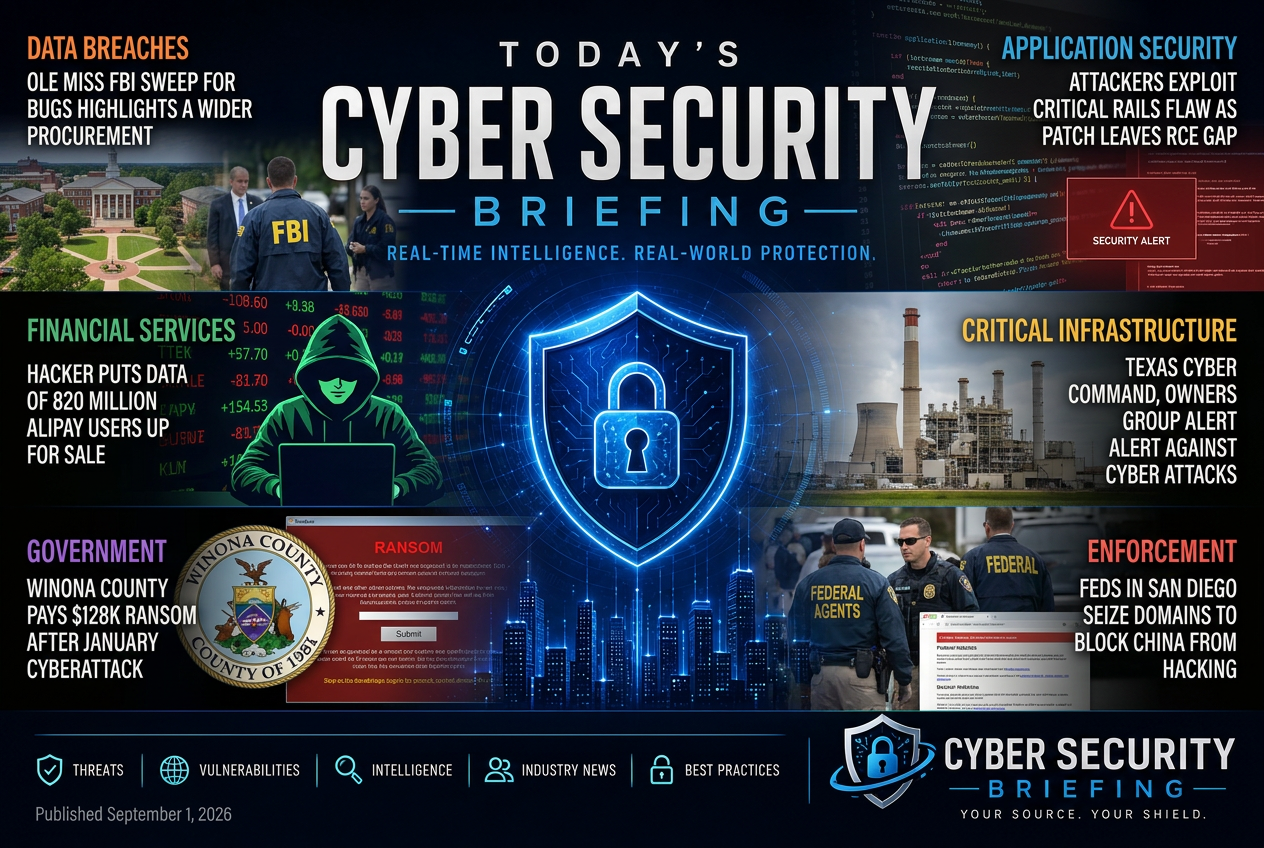
Today's briefing brings you 57 stories across data breaches, application security, critical infrastructure and government from the global cybersecurity industry. Leading today: Ole Miss FBI Sweep for Bugs Highlights a Wider Procurement Push in College Athletics Security.
data-breaches
An FBI sweep of Ole Miss's football offices for hidden bugs fits into a much larger pattern of colleges buying up cybersecurity and monitoring tools.
From Our Desk
A large set of Alipay user data is being offered for sale, which points to a potential exposure of sensitive financial and identity information. Defenders should treat this as a data-breach and fraud risk, with likely follow-on abuse such as account takeover, phishing, and identity theft.
Breaches & incidents
McKesson is dealing with the operational and reputational fallout from an extortion attack that involved data theft. For defenders, the immediate concern is exposure of sensitive data and the follow-on obligations around containment, notification, and customer or partner trust.
Breaches & incidents
Colorado’s secretary of state data breach exposed voter-related information and pulled in a high-profile political opponent among the affected people. For defenders, this is a government data exposure issue that raises identity theft, election integrity, and public trust concerns.
Breaches & incidents
Kiewit says it has suffered a data breach that could affect a large number of people, which raises the risk of exposed employee or identity data. Defenders should treat this as a notification that may require account review, identity protection steps, and internal incident response follow-up.
Breaches & incidents
The settlement suggests the breach litigation against a mortgage company has moved from exposure into financial resolution. For defenders, this is another reminder that customer data incidents can lead to costly enforcement and class-action-style legal fallout, especially in regulated financial services.
Regulation & Enforcement
application-security
Attackers are actively exploiting a critical Ruby on Rails vulnerability, and the reporting says the initial patch left an RCE path open. For defenders, this raises immediate exposure in internet-facing Rails applications and creates an obligation to verify that patched systems are actually no longer reachable through the flaw.
Vulnerabilities & Exploitation
A critical vulnerability in Ruby on Rails is being actively discussed as a target for attackers. Defenders should treat this as an application security and patching priority because exposed Rails applications may face exploitation attempts before remediation is complete.
Vulnerabilities & Exploitation
critical-infrastructure
Texas officials and an owners group are warning about cyber attacks aimed at critical infrastructure. For defenders, the immediate issue is exposure of operational environments in one state, which raises the need to review segmentation, monitoring, and incident response coordination with local authorities and asset owners.
Critical Infrastructure & OT
India’s digitising critical sectors are widening the attack surface beyond the traditional focus on banks and healthcare. For defenders, that raises the need to prioritise sector-wide resilience, not just standalone enterprise security, across critical infrastructure and OT environments.
Critical Infrastructure & OT
The piece frames water systems as a cyber target and a public-safety issue, which raises the stakes for utilities, local governments, and the operators that support them. For defenders, the main concern is exposure in OT and critical-infrastructure environments where disruption can affect service continuity and physical outcomes, so monitoring, segmentation, and incident response planning matter.
Critical Infrastructure & OT
A regulatory hearing on Halifax Water’s cybersecurity suggests a formal review of how a public utility is protecting itself from digital risk. For defenders, the main impact is added scrutiny on critical-infrastructure security controls, governance, and compliance obligations.
Funding, M&A and the Vendor Market
Tenable is joining a White House-led effort focused on improving cybersecurity for U.S. water systems. For defenders, this points to continued scrutiny on critical infrastructure operators and the need to harden OT environments that support essential public services.
Critical Infrastructure & OT
House lawmakers are preparing to mark up several bills aimed at technology security threats. For defenders, this points to possible new federal obligations for security controls, reporting, or oversight in areas tied to critical infrastructure and technology security.
Critical Infrastructure & OT
The piece points to cyber risk in telecom and frames the topic around common threat areas and defense approaches. For defenders, the main value is prioritizing telecom as critical infrastructure with exposure across networks, identity, and service availability.
Regulation & Enforcement
government
Winona County says it paid a ransom after a January cyberattack. For defenders, this points to a local government incident with recovery and continuity implications, and it reinforces the need to plan for ransomware response before an attack reaches the payment decision stage.
Breaches & incidents
Switzerland is preparing to launch a new registry while warning signs about cyberattack risk are already part of the story. For defenders, the main issue is launch-time exposure: a new public or shared registry can become an early target for disruption, abuse, or data exposure if security controls are not hardened before go-live.
Breaches & incidents
enforcement
Federal authorities in San Diego seized domains as part of an effort to disrupt Chinese hacking activity. For defenders, this points to active U.S. government enforcement against foreign threat infrastructure and may reduce exposure from those domains, while also signaling continued pressure on organizations tied to cross-border cyber operations.
Threat Actors & Campaigns
Australian and US law enforcement say they disrupted a cross-border cybercrime network tied to crypto laundering. For defenders, the main issue is enforcement pressure on criminal infrastructure and the need to watch for laundering links that can connect fraud, identity abuse, and other cyber incidents.
Identity, Cloud & Software Supply Chain
cryptography
North Korean-linked hackers are targeting crypto and other digital asset holdings, which raises the risk of theft, laundering and broader financial disruption for exchanges, custodians and investors. Defenders should treat this as an adversary that blends cyber intrusion with financial crime and review controls around wallet security, transaction monitoring and third-party access.
Threat Actors & Campaigns
financial-services
Attackers manipulated a crypto token price and used that distortion to drain funds from the Tectonic platform. Defenders should treat this as a warning about price-oracle abuse and market manipulation in DeFi systems, where a weakness in asset valuation can become a direct theft path.
Vulnerabilities & Exploitation
Jack Henry says a cyber incident did not interrupt client systems. For defenders, the key issue is operational resilience and the possibility that a vendor-facing incident can still create exposure even when service availability is preserved.
Regulation & Enforcement
Banks are being told that older identity security practices are no longer enough for their current risk environment. The piece appears to focus on how identity controls now affect exposure, control priorities, and compliance expectations in financial services.
Identity, Cloud & Software Supply Chain
Switzerland is moving ahead with a transparency register even though there are concerns that it could create a target for hackers. For defenders, the issue is increased exposure around sensitive ownership and financial data, along with a compliance obligation to secure the register and the systems that support it.
Funding, M&A and the Vendor Market
This piece appears to focus on PCI DSS 4.0 audit preparation and cybersecurity assessment work for organizations that handle payment card data. For defenders and compliance leaders, the practical issue is maintaining audit readiness, proving control effectiveness, and reducing the risk of findings tied to payment security obligations.
Regulation & Enforcement
endpoint
Microsoft says attackers are using TerminalFix to set up reverse tunnels, which gives them a way to reach into targeted systems and keep access open. Defenders should treat this as an endpoint and network visibility issue, with attention on unusual tunneling behavior, remote access paths, and any signs of persistence on affected hosts.
Threat Actors & Campaigns
India has issued a cyber fraud warning tied to porn app scams that use malicious APKs to infect phones and drain bank accounts. For defenders, the priority is user education, mobile app vetting, malware detection, and controls that reduce the impact of device compromise on financial accounts.
Vulnerabilities & Exploitation
Attackers are using compromised PaperCut servers to drop remote access tools, which turns a printer-management foothold into broader network persistence. Defenders should treat exposed PaperCut systems as a priority because compromise can lead to long-lived access beyond the initial exploit.
Vulnerabilities & Exploitation
The report points to a Windows privilege-escalation issue tied to Kaspersky Endpoint Security. For defenders, that raises the priority of endpoint hardening, vendor patch tracking, and checking whether security tooling itself could be used to gain elevated access on Windows 11 systems.
AI Security
Anthropic users are being targeted with infostealer malware and session theft attempts, which puts account access and authenticated sessions at risk. Defenders should treat this as an identity and endpoint problem, not just a vendor-specific issue, because stolen browser sessions can bypass normal login controls.
Threat Actors & Campaigns
A fake Chrome update prompt is being used as a delivery method for malware. Defenders should treat this as a browser-facing social engineering threat that can lead to endpoint compromise, so user awareness, web filtering, and controls on software installs matter.
Threat Actors & Campaigns
ai-security
The piece points to faster AI-enabled attack activity and the pressure that puts on Israel's critical infrastructure defenders. For security leaders, the main issue is a higher attack surface across cloud and operational systems, which raises the priority of monitoring, segmentation, and incident response readiness.
Identity, Cloud & Software Supply Chain
Security leaders need to treat privileged access as a control point, not just an administrative convenience. The piece appears to focus on how defenders should tighten who can use high-level accounts, since misuse of privileged credentials is a common path to broader compromise.
AI Security
AI may make government offensive hacking operations harder to run if defenders can use the same tools to spot, analyze, and block malicious activity faster. For security teams and public-sector risk owners, the practical issue is exposure to state-linked tradecraft and the need to adapt controls, detection, and legal oversight around sanctioned cyber tools.
Regulation & Enforcement
The piece frames AI models themselves as a supply chain risk, which matters for organizations that rely on third-party models, model updates, or hosted AI services. Defenders should treat model provenance, integrity, and dependency management as part of supply chain security, not just an AI feature issue.
AI Security
ChatGPT is now subject to stricter EU oversight, which puts AI providers under more direct compliance pressure in Europe. For defenders, this raises the bar for governance, documentation, and risk management around how generative AI systems are deployed and monitored.
AI Security
The story says the Cloud Security Alliance is highlighting identity and AI as leading cloud security concerns. For defenders, that points to sharper focus on access controls, identity governance, and how AI is being introduced into cloud environments.
Identity, Cloud & Software Supply Chain
LastPass is expanding tools aimed at SaaS and identity security, which matters because identity controls are a primary target when attackers use automation and AI. For defenders, this is mainly an exposure and priority issue: review how well identity governance, SaaS access controls, and credential protections are covered by existing programs.
Identity, Cloud & Software Supply Chain
Smart home routers can become a security weak point when they are used as part of an AI agent’s attack surface. For defenders, the issue is exposure in consumer and small-office networks, where weak router security can be used to reach devices, services, or data behind the perimeter.
AI Security
This is an informational piece about how AI is used in cybersecurity and the associated benefits, risks, and threats. For defenders, it points to both a capability issue and an exposure issue, since AI can support security operations while also being used by threat actors.
Threat Actors & Campaigns
Broadcom is expanding its security product line with new and updated controls aimed at agentic AI environments. For defenders, the practical issue is not a single breach but the need to assess whether existing network, cloud, and application security tools can govern AI-driven agents and the systems they touch.
AI Security
CrowdStrike is being judged on whether its AI security push translates into credible product depth and customer value. For defenders, the main issue is whether the expansion improves detection and response or simply adds another vendor narrative to evaluate and govern.
AI Security
Legal teams are being pushed to put human review between AI output and final legal decisions. For defenders, the issue is governance and accountability: if AI is used in legal workflows, organizations need clear escalation paths, review thresholds, and auditability to limit bad advice, confidentiality errors, and compliance exposure.
AI Security
Athena Agentic is expanding its cybersecurity software portfolio by acquiring Omni Cyber Solutions' AI platform. For defenders and buyers, this is mainly a vendor-market signal that could change product direction, support, and integration plans, so procurement and risk teams should track what capabilities are being folded into the combined offering.
Funding, M&A and the Vendor Market
LastPass is positioning a secure access update as part of broader identity security efforts, with an emphasis on AI-era risk. For defenders, the main question is whether the product reduces exposure around credential use and access control, and whether it changes procurement or configuration obligations for organizations already using it.
Identity, Cloud & Software Supply Chain
CrowdStrike is adding a tool meant to automate workflows for securing AI systems. For defenders, this points to more operational support around AI security rather than a new threat incident, and it may help teams standardize how they handle AI-related risk.
AI Security
Security Risk Advisors is offering a free AI platform aimed at SOC workflows. For defenders, the immediate issue is whether the tool improves analyst efficiency without creating new data handling, model governance, or vendor risk in security operations.
AI Security
Harsh Verma at Palo Alto Networks is reported to have received two AI security awards. For defenders, this reads as recognition of vendor-side work in AI security rather than a disclosure of a new threat, control gap, or regulatory duty.
AI Security
software-supply-chain
A malicious worm has been found in a popular npm package used by developers, and its goal is to steal secrets from infected systems. Defenders should treat this as a software-supply-chain exposure that can affect build pipelines, developer machines, and any downstream software that depends on the package.
Identity, Cloud & Software Supply Chain
network-security
Chinese Fire Ant is abusing Cisco routers as covert infrastructure for surveillance. For defenders, the exposure is network edge devices that may sit outside normal endpoint monitoring, so the priority is to harden, patch, and audit router management and logging controls.
Threat Actors & Campaigns
healthcare
McKesson says a cyberattack is affecting service availability, which puts operational continuity ahead of any confirmed disclosure at this stage. For defenders in healthcare and adjacent supply chains, the immediate concern is resilience of business-critical systems and the downstream impact on medication distribution and customer service.
Breaches & incidents
threats
A threat actor identified as Nightmare Eclipse is distributing exploit code targeting a Kaspersky product. Defenders should treat this as a vendor-product exposure with possible follow-on risk to endpoints that rely on the affected software and to organizations that have not yet validated patch status or mitigations.
Vulnerabilities & Exploitation
incidents
Ontology has paused its blockchain after identifying a potential security vulnerability. For defenders, this is a reminder that blockchain platforms can still face operational risk from exposed weaknesses, and incident response plans should account for service interruption as well as exploitation.
Vulnerabilities & Exploitation
cloud-security
The piece appears to examine how cloud control architecture affects executive exposure to cloud-related risk. For defenders and risk leaders, that means treating cloud governance and control design as an executive risk issue, not just a technical configuration problem.
Identity, Cloud & Software Supply Chain
Cloud logging can create records, but it does not by itself make an organization ready to respond to an incident. The practical issue for defenders is whether logs are usable, centralized, and tied to detection and response procedures before an attack or outage forces the issue.
Identity, Cloud & Software Supply Chain
funding-m-a
Transcat is buying Southeastern Biomedical, which points to continued consolidation in the biomedical equipment services market. For defenders and healthcare operators, the main relevance is vendor and service-provider concentration, which can affect procurement, support continuity, and third-party risk oversight.
Funding, M&A and the Vendor Market
Technology
This is a list-style hiring post, not an incident or policy development. For defenders, it mainly signals labor-market demand and a continuing need for security talent across roles.
Regulation & Enforcement