
Cyber Security Briefing Briefing — September 2, 2026
Wednesday, September 2, 2026
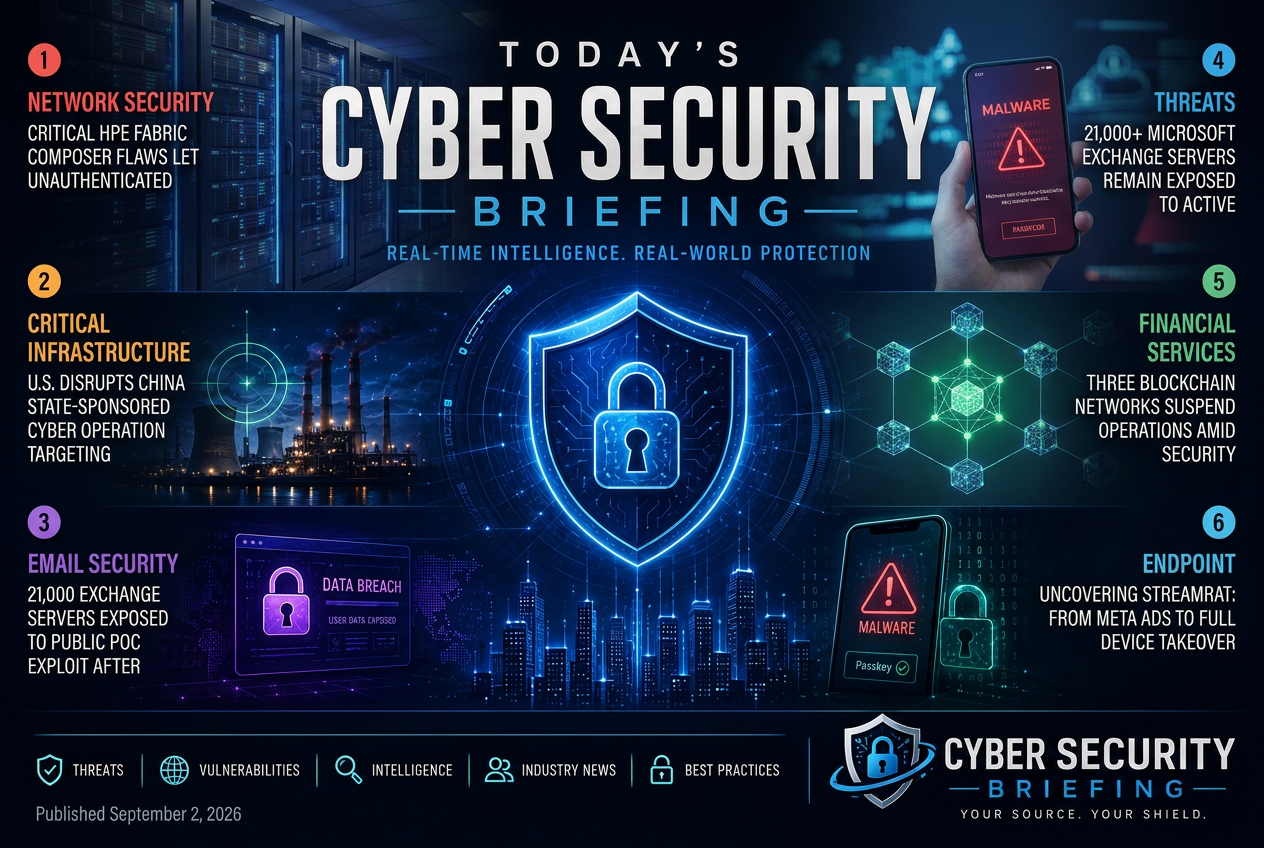
Today's briefing brings you 137 stories across network security, critical infrastructure, email security and financial services from the global cybersecurity industry. Leading today: Critical HPE Fabric Composer Flaws Let Unauthenticated Attackers Execute Code and Take Over Systems - CyberSecurityNews.
network-security
HPE Fabric Composer has reported flaws that allow unauthenticated remote code execution and full system compromise. Defenders using the product should treat this as an urgent exposure in a vendor management and patching review, because the issue affects the control plane for network infrastructure rather than a single endpoint.
Vulnerabilities & Exploitation
SonicWall’s SMA1000 remote access appliance is implicated in a second zero-day attack chain in less than two months. Defenders should treat this as an active vendor-product exposure with a repeatable SSRF-to-injection path and prioritize patching, exposure review, and log hunting for compromise indicators on internet-facing appliances.
Vulnerabilities & Exploitation
Cisco routers are being described as part of a cyber espionage or malware campaign rather than just as networking infrastructure. For defenders, that raises the priority of router hardening, firmware review, and monitoring for misuse of network devices as persistence or collection points.
Threat Actors & Campaigns
critical-infrastructure
U.S. authorities disrupted a China-linked cyber operation aimed at critical infrastructure. For defenders, the immediate issue is exposure in operational technology and other infrastructure environments, along with the need to review detection, segmentation, and incident response for state-sponsored intrusions.
Critical Infrastructure & OT
The piece describes a cybersecurity control for military nuclear reactors, which places a hard security requirement on highly sensitive critical infrastructure. For defenders, the main takeaway is exposure at the intersection of defense, nuclear safety, and operational technology, where a compromise could affect both availability and physical safety.
Critical Infrastructure & OT
Cyberattacks are affecting Latin American energy organizations more than other sectors in the region. For defenders, that raises the priority of protecting operational technology, remote access, and other critical-infrastructure systems that can disrupt service if compromised.
Funding, M&A and the Vendor Market
Connected medical devices expand the attack surface in healthcare, and pacemakers and similar life-sustaining equipment raise the stakes from data theft to patient safety. Defenders need to treat these devices as critical assets, with tighter inventory, segmentation, vendor oversight, and incident response plans that account for clinical disruption.
Breaches & incidents
Hackers are using compromised Cisco routers for network spying and as a path toward critical infrastructure. For defenders, this raises exposure in network-edge devices and makes router hardening, monitoring, and incident response a higher priority across operational and enterprise environments.
Critical Infrastructure & OT
US companies are seeing more cyber attacks, which raises exposure for corporate networks, customer data, and connected operational systems. For defenders, the practical takeaway is to tighten detection, review external attack surface, and prioritize assets that support business continuity and critical operations.
Critical Infrastructure & OT
Texas is piloting new defenses for water systems against cyberattacks. For defenders, the immediate issue is exposure in critical infrastructure and OT environments, along with the need to harden utilities that may not have mature cyber controls.
Critical Infrastructure & OT
Siemens is being pulled in two directions: it is dealing with cyber alerts tied to its factory-floor environment while also challenging Brussels on policy. For defenders, the operational concern is that an industrial manufacturer under cyber pressure may face higher exposure in OT systems and greater scrutiny of how it responds.
Critical Infrastructure & OT
The report says alleged Iranian cyberattacks against U.S. infrastructure did not succeed. For defenders, the main issue is continued threat pressure on critical infrastructure and the need to keep monitoring, hardening, and incident response plans current.
Critical Infrastructure & OT
The Coast Guard has created a new office to shape maritime cybersecurity policy. For defenders, this increases regulatory attention on shipping and port operations and signals that maritime cyber risk is becoming a formal compliance and enforcement issue, not just an operational one.
Regulation & Enforcement
The piece appears to focus on how the EU Machinery Regulation will push cybersecurity requirements into industrial compliance. For defenders, that means more scrutiny on machinery security, OT environments, and evidence that technical controls and governance meet regulatory expectations.
Regulation & Enforcement
This appears to be a policy and security discussion about how NATO depends on protected transport and other critical infrastructure to move military forces. For defenders, the main issue is exposure across civilian transport systems and the obligation to harden those assets against disruption that could affect alliance mobility.
Critical Infrastructure & OT
Texas is launching a cybersecurity program for the water sector, which puts a clear focus on protecting local critical infrastructure and OT environments. For defenders, the immediate impact is added attention on water utilities' exposure and a stronger expectation to align security controls with operational risk and compliance needs.
Critical Infrastructure & OT
The piece is about governance as a control layer for protecting critical assets, which matters most for defenders responsible for high-value systems and regulated environments. For security leaders, the practical signal is that accountability, oversight, and policy enforcement are part of the defense surface, not just technical controls.
Regulation & Enforcement
Cognizant is deepening its use of CrowdStrike to secure operations that span both IT and OT environments. For defenders, this points to tighter convergence of endpoint and industrial monitoring, with more emphasis on protecting critical infrastructure from disruptions that move across corporate and operational networks.
Critical Infrastructure & OT
Rockwell Automation says it is working with Mimosa Mine and Mine Elect on a cybersecurity and modernization effort in Zimbabwe. For defenders, this points to ongoing OT security and upgrade work in a mining environment, with attention on operational resilience and reducing exposure in industrial systems.
Critical Infrastructure & OT
The piece is an opinion essay about who is responsible for protecting Pakistan’s digital environment. For defenders, the issue is governance and accountability: it points to a need to clarify which institutions own cybersecurity, critical-infrastructure protection, and day-to-day incident response.
Critical Infrastructure & OT
email-security
Public proof-of-concept code for an Exchange exploit chain has widened the exposure window for defenders that still have internet-facing servers. The immediate issue is prioritizing patching, mitigation, and exposure review for Exchange systems that may now be reachable by attackers using the published exploit path.
Vulnerabilities & Exploitation
Microsoft Exchange servers remain exposed to active exploitation of a reported vulnerability. For defenders, this is an immediate patching and exposure-management issue, with priority on finding internet-facing Exchange systems, validating remediation, and checking for signs of compromise.
Vulnerabilities & Exploitation
xorlab has raised funding to expand an email security platform aimed at European sovereignty requirements. For defenders, the main impact is a new vendor option in a sensitive control area where data residency, trust, and procurement constraints matter for public sector and regulated buyers.
Funding, M&A and the Vendor Market
financial-services
Three blockchain networks halted operations after security incidents, which points to an active compromise or defensive shutdown affecting their availability and trust. Defenders should treat this as a warning about operational concentration risk in crypto infrastructure and the need to monitor for related attack patterns, incident response gaps, and user exposure across connected services.
Vulnerabilities & Exploitation
endpoint
ThreatFabric says this campaign uses Meta ads to deliver StreamRat and reach full device takeover on the victim side. For defenders, that raises exposure through ad-driven delivery and points to a mobile endpoint threat that can bypass normal user caution and expand into account and device compromise.
Threat Actors & Campaigns
A state-linked Iranian threat group is using fake job assessments as a delivery path for malware. The main defender impact is exposure to social engineering against recruiters, job seekers, and anyone handling unsolicited test files, which raises the priority for file handling controls, user training, and monitoring for suspicious campaign infrastructure.
Threat Actors & Campaigns
Authorities have disrupted the Sality botnet, a long-running malware network that likely affected many infected Windows systems and the operators behind them. For defenders, this lowers one source of distributed malware activity, but it also reinforces the need to find and clean up legacy infections that can survive for years on unmanaged endpoints.
Critical Infrastructure & OT
Google Chrome and Mozilla Firefox have both received security updates that fix many vulnerabilities. For defenders, this is a routine but important patching event that raises endpoint exposure until browsers are updated, especially because browsers are a common attack surface for drive-by compromise and malicious web content.
Vulnerabilities & Exploitation
Google Chrome received a security update that closes multiple vulnerabilities, including two critical use-after-free flaws. For defenders, this is a straightforward patching priority because browser vulnerabilities can be used to compromise endpoints through normal web activity.
Vulnerabilities & Exploitation
The story points to a Windows backdoor that remains inactive until it receives a trigger from the attacker. For defenders, that raises the priority on endpoint detection, memory and process monitoring, and hunting for command-and-control behavior that may not show up through normal execution paths.
Threat Actors & Campaigns
A reported zero-day affecting Avast Antivirus puts endpoint protection software itself in scope, which raises the urgency for defenders who rely on that product. Security teams should treat this as a vendor-product risk with possible exposure across managed endpoints and check for any available guidance, detection updates, or mitigations from the vendor and researchers.
Threat Actors & Campaigns
Microsoft is describing a deceptive software download campaign that uses counterfeit installers to compromise systems. For defenders, this raises exposure at the endpoint and software acquisition layer, and it reinforces the need to verify download sources, inspect installer behavior, and treat unsigned or unexpected installers as suspicious.
Identity, Cloud & Software Supply Chain
This piece appears to focus on the operational challenge of getting security patches applied during limited maintenance windows. For defenders, the main issue is exposure from delayed remediation and the need to prioritize patching, downtime, and change control together.
Vulnerabilities & Exploitation
The story says a backdoor is hiding inside an ESET agent and only activates when it receives a network trigger. For defenders, that raises the priority of endpoint trust, software integrity, and network monitoring because a legitimate security tool can be used as the delivery path for malware.
Threat Actors & Campaigns
Attackers are using a fake Claude Opus 5 app as a lure to deliver RevStealer, a malware family aimed at collecting passwords and cryptocurrency-related data. Defenders should treat this as a phishing and malware delivery problem that combines brand impersonation, endpoint risk, and credential theft exposure.
Identity, Cloud & Software Supply Chain
This piece appears to be vendor guidance aimed at organizations that store sensitive data on devices or in other places outside the network perimeter. The defender takeaway is to treat data protection as a broader exposure problem, with attention on endpoint storage, access control, and handling practices rather than only network defenses.
Identity, Cloud & Software Supply Chain
cryptography
A layer-1 blockchain reportedly halted operations for several hours to contain a loss event tied to a multimillion-dollar hack. For defenders, this is an availability and governance issue as much as a financial one: it shows that blockchain operators may need emergency controls, incident response, and transparent disclosure practices when a protocol is under active exploitation.
Vulnerabilities & Exploitation
The SEC is proposing changes to how transfer agents handle tokenized securities and blockchain-based recordkeeping. For defenders and compliance leaders in financial services, this signals a likely shift in recordkeeping, custody, and supervisory obligations for firms that touch digital securities infrastructure.
Regulation & Enforcement
application-security
Attackers are targeting Langflow through CVE-2026-0768, which puts defenders on notice for exposure in a specific application platform rather than a broad campaign. Security teams should treat this as a patching and detection priority for any environment that uses Langflow.
Vulnerabilities & Exploitation
The headline points to an emergency briefing about a likely npm package supply-chain compromise. For defenders, the main issue is exposure in software dependency management and the need to verify whether any internal builds, deployed applications, or downstream customers pulled the affected package.
Identity, Cloud & Software Supply Chain
RapidFort says it is integrating with CrowdStrike Falcon Cloud Security to speed up remediation of container vulnerabilities. For defenders, this is a cloud and application security workflow issue: it affects how quickly teams can identify, prioritize, and fix exposed container images and related supply-chain risks.
Identity, Cloud & Software Supply Chain
CISA is arguing that some recurring software weakness classes should be reduced or removed from the development and security process, which shifts attention from reacting to individual bugs toward preventing whole categories of defects. For defenders, the practical effect is more pressure on engineering, procurement, and risk teams to track which weaknesses keep reappearing and to push vendors toward stronger secure-by-design practices.
Vulnerabilities & Exploitation
identity-access
A vulnerability in Cleo Harmony can let a remote attacker use a JWT refresh token to raise privileges. For defenders, this is an application and identity-access issue that affects any exposed Harmony deployment and warrants prompt patching and token handling review.
Vulnerabilities & Exploitation
The piece appears to focus on FortiBleed as an example of how attackers can make security controls irrelevant once credentials are stolen. For defenders, the practical lesson is that patching and detection alone are not enough; identity protection, session control, and stronger monitoring of misuse become the priority.
Vulnerabilities & Exploitation
ai-security
The piece says attackers used prompt wording to steer an AI coding assistant into helping with hacking activity. For defenders, that raises the priority of prompt-injection controls, tool-use restrictions, logging, and human review for any AI system that can execute or suggest security-sensitive actions.
AI Security
A flaw in Hugging Face Transformers can let attacker-controlled Python code be written before a user has given consent. Defenders should treat this as a supply-chain and application security issue that could expose systems using the library to code execution during model or package handling.
Vulnerabilities & Exploitation
AI-assisted attacks can lower the cost and skill needed to probe energy systems, which raises exposure for operators of power generation, transmission, and related OT environments. Defenders should treat this as a signal to tighten monitoring, harden remote access, and review incident response plans for critical infrastructure environments.
Critical Infrastructure & OT
The piece says an AI application framework has now had multiple exploited vulnerabilities, and that attackers are using it as part of credential-harvesting activity. For defenders, the exposure is broader than a single product flaw: AI frameworks need the same patching, hardening, and monitoring attention as other internet-facing software, especially where they can be used to reach secrets or authentication material.
Vulnerabilities & Exploitation
AI is lowering the cost and speed of cyberattacks, which raises the baseline threat for banks and other market participants. For defenders, the issue is less about a new attack class than about greater volume, faster iteration, and more pressure on monitoring, fraud controls, and incident response.
Vulnerabilities & Exploitation
Energy firms are facing a higher cyber risk as they connect more systems and operations. For defenders, this raises exposure in operational technology, network boundaries, and AI-assisted attack paths, so connectivity programs need tighter segmentation, monitoring, and access control.
Critical Infrastructure & OT
Montana’s attorney general has opened an investigation into OpenAI after a reported data breach. For defenders, this raises the profile of AI vendor security and increases scrutiny on how customer or user data is stored, accessed, and disclosed.
Regulation & Enforcement
Regulators are warning that AI systems can behave in unsafe or uncontrolled ways and are calling for emergency measures. For defenders, this raises the priority on AI governance, model oversight, and controls around how AI tools are deployed and monitored.
Vulnerabilities & Exploitation
The piece describes a test showing that AI can help adapt a PLC exploit quickly and at relatively low cost. For defenders in industrial environments, that raises the risk that exploit development and modification can be compressed into a shorter window, which increases the need to harden OT assets, monitor for unusual testing activity, and review exposure around vulnerable controllers.
Vulnerabilities & Exploitation
The report points to malware being used to support an underground market for selling access into corporate networks. For defenders, that means the immediate risk is not just endpoint infection but the resale of valid access, which raises the priority on credential hygiene, access monitoring, and rapid containment of compromised accounts.
Threat Actors & Campaigns
The report says AI agents were able to find zero-day weaknesses that could let an attacker escape a virtual machine. For defenders, that raises the priority of testing isolation controls and treating AI-assisted vulnerability discovery as a real risk to cloud and virtualized environments.
Vulnerabilities & Exploitation
Recorded Future is arguing that security operations need agentic AI that supports real detection and response work, not surface-level automation claims. For defenders, the main issue is whether AI tools reduce analyst burden and improve response quality without creating new blind spots in SOC operations and governance.
AI Security
Upwind has raised new funding at a multibillion-dollar valuation, which signals continued investor interest in AI-focused cloud security vendors. For defenders, the immediate impact is vendor-market pressure: more capital can mean faster product development, broader sales coverage, and a stronger competitive push in an already crowded security category.
Funding, M&A and the Vendor Market
Spain’s data protection authority has published guidance on how to design and govern agentic AI systems. For defenders and compliance teams, this raises the priority on AI architecture reviews, data handling controls, and accountability for systems that can take actions with limited human input.
Regulation & Enforcement
Palo Alto Networks is framing cyber risk as a large legacy backlog that enterprises still have not closed, while arguing that AI is making the threat environment more urgent. For defenders, the message is that exposure is rising faster than many security programs have reduced basic gaps, which increases pressure on remediation, modernization, and board-level risk oversight.
Funding, M&A and the Vendor Market
Prompt injection is being framed here as more than a single-shot attack on an AI system. For defenders, that raises the concern that malicious instructions can spread through workflows or outputs and turn one compromised interaction into a broader security and governance problem.
AI Security
The headline points to commentary on a gap in AI governance and what it means for security teams. For defenders, that raises exposure around how AI tools are approved, monitored, and controlled, and it adds compliance pressure where policy and oversight are lagging.
AI Security
The piece appears to describe a vulnerability in NVIDIA’s NeMo chat template handling that could let an attacker poison prompts or model behavior through template manipulation. For defenders, that raises the priority of reviewing AI application inputs, template controls, and any downstream systems that trust model-generated output.
AI Security
The piece points to fraud and authentication risks around agentic UPI as NPCI works on a unified agent protocol. For defenders in banks and payment platforms, the immediate concern is stronger identity controls, tighter transaction verification, and monitoring for new fraud patterns tied to AI-assisted payment flows.
AI Security
The piece appears to examine how agentic AI-driven attacks create different defensive problems for banks than for other organizations. For defenders, the main issue is exposure across financial-services workflows and the need to prioritize controls around identity, access, and AI use inside regulated environments.
AI Security
This piece signals that identity and access security is being reshaped by agentic AI, with vendors positioning their platforms around machine-driven actions rather than only human users. For defenders, that raises the priority of controlling non-human identities, privileges, and access paths across cloud and enterprise systems.
Funding, M&A and the Vendor Market
Anthropic is releasing a new AI model while security concerns around AI systems are rising. For defenders, this mainly affects exposure and priority: it underscores the need to assess how new models are being used, what data they can reach, and what controls are in place around prompts, outputs, and access.
AI Security
Microsoft is adding more oversight around agentic AI and publishing those controls in its transparency reporting. For defenders, the main impact is in governance and compliance: it signals tighter expectations for how AI systems are evaluated, monitored, and documented before and after release.
AI Security
OpenAI says a new safeguard would have stopped a large set of rogue AI agents sooner. For defenders, the issue is exposure to uncontrolled agent behavior and the obligation to treat AI systems as security-controlled assets rather than trusted automation.
AI Security
Security is being framed as a prerequisite for AI deployment, not an optional control. For defenders, that points to higher scrutiny on AI systems, governance, and the security checks needed before adoption in regulated environments.
Regulation & Enforcement
The report says AI was used to help build the Gryxa malware operation, which points to AI-assisted threat development rather than a purely manual campaign. Defenders should treat this as a sign that malware creation and operator workflows may be accelerating and becoming easier to scale.
Threat Actors & Campaigns
Visa is expanding its AI-based cybersecurity tooling and advisory support to speed up threat remediation for its customers and partners. For defenders, this points to a stronger expectation to use vendor-provided automation and guidance to reduce response time and limit exposure when attacks are detected.
Vulnerabilities & Exploitation
CrowdStrike is adding new AI models aimed at security workflows, with Nvidia as a partner. For defenders, this points to more AI-assisted vendor products in the security stack, which raises the need to assess model behavior, data handling, and operational trust before deployment.
AI Security
CrowdStrike’s Fal.Con remarks point to a shift in how defenders are expected to use AI, with security operations moving toward faster, machine-assisted detection and response. For defenders, the main impact is operational: teams will need to adjust workflows, tooling, and oversight so they can keep pace with attack speed without losing control.
Threat Actors & Campaigns
Israeli startups continue to draw substantial investment, with AI security taking a leading share of the funding story. For defenders, this points to continued vendor activity and a crowded market around tools meant to reduce AI-related risk, which affects procurement, evaluation, and monitoring priorities.
Funding, M&A and the Vendor Market
OpenAI is restricting access to cybersecurity functions in its new Astra model. For defenders, that means less immediate exposure to dual-use AI capabilities, but also a sign that vendors are trying to control how security-relevant features are distributed and governed.
Funding, M&A and the Vendor Market
The piece appears to treat a security incident around Hugging Face as part of a wider pattern of risk in AI and software supply chains. For defenders, that raises the priority of reviewing third-party model and package trust, access controls, and monitoring for malicious content or dependencies pulled from AI platforms.
Identity, Cloud & Software Supply Chain
WordPress is using AI to identify security flaws in its software before attackers can exploit them. For defenders, this raises the value of faster vulnerability discovery and patching, and it points to a stronger expectation that platform vendors will use automation to reduce exposure in widely deployed software.
Vulnerabilities & Exploitation
The report points to a gap between hospital AI adoption and cybersecurity readiness. For defenders, that raises exposure in healthcare environments and increases the need to treat AI systems as part of the regulated attack surface, not as separate innovation projects.
Regulation & Enforcement
Reco says it has released a browser security product aimed at runtime protection for AI systems and agents. For defenders, this points to a vendor push to reduce exposure in browser-based AI workflows and to add controls around agent activity at the point of use.
AI Security
CrowdStrike is pushing further into AI security, which puts attention on how enterprises protect AI-enabled systems and the data they touch. For defenders, the practical issue is whether this adds new controls, monitoring needs, or vendor risk inside customer experience environments that increasingly rely on AI.
AI Security
VAST Data is adding CrowdStrike integrations that bring Falcon sensor support into its platform, with SIEM and AI-driven detection features listed as previews. For defenders, this points to tighter linkage between storage infrastructure and endpoint security, and it shifts attention to how much telemetry can be centralized and acted on from one vendor stack.
AI Security
This piece appears to be guidance on hardening security controls as organizations adopt AI, with an emphasis on reducing risk during the transformation. For defenders, the main impact is operational: review exposure in AI-related tooling, data handling, and access controls before rollout, and treat AI adoption as a security governance issue as much as a technology project.
AI Security
Cherry Hill Advisory is using AI agents to support equity quality audits, which signals more automation in accounting and assurance workflows. For defenders, the main issues are vendor risk, data handling, and whether AI outputs are being relied on without enough human review.
AI Security
ITCEN Group is launching a product aimed at securing enterprise AI use in South Korea. For defenders, this points to growing demand for controls around AI systems, especially where organizations are trying to manage exposure from enterprise deployment rather than just block consumer use.
AI Security
This is an interview-style piece about how AI is changing the pace and tactics of cyber defense. For defenders, the main implication is higher operational pressure: faster attack cycles, faster detection needs, and more urgency around automation and response quality.
Threat Actors & Campaigns
Filigran is adding AI-driven attack chaining to OpenAEV, which means the product is moving further into autonomous security testing. For defenders, this raises the value of validating controls against more realistic attack paths, but it also increases the need to govern how agentic tools are used, what data they touch, and who can run them.
AI Security
This is a vendor product announcement about an AI assistant for cybersecurity teams. The defender impact is mainly on workflow and trust: teams may use it to speed research and decision-making, but they still need to verify the sources and limits of its answers before relying on it for operational or compliance work.
Regulation & Enforcement
Askeal has raised early-stage funding for an AI security assistant built around community input. For defenders, this is mainly a signal of continued investment in AI-enabled security tools, with attention on whether the product helps analysts reduce manual triage or adds another vendor to evaluate for trust, data handling, and operational fit.
AI Security
Integris is buying First Focus to broaden its managed AI capabilities. For defenders, this is mainly a vendor-market and exposure question: organizations using or evaluating managed AI services should assess how the combined provider handles data access, model governance, and third-party risk.
Funding, M&A and the Vendor Market
This piece is a call for shared defenses around AI systems. For defenders, the main implication is that AI security is a collective obligation: organizations need to treat AI risk as something that crosses vendors, teams, and sectors rather than a problem each entity can solve alone.
AI Security
This piece appears to describe a vendor-built cybersecurity system that uses an agentic AI model to support adaptive defense workflows. For defenders, the main impact is on tooling and operations: it points to a shift toward AI-assisted detection, response, and automation, with corresponding questions about control, validation, and security of the model itself.
Regulation & Enforcement
defense
The headline points to a geopolitical escalation with cyber retaliation as part of the response. For defenders, that raises the likelihood of spillover attacks against government, defense, and critical-infrastructure targets, and it shifts attention toward monitoring for state-linked activity, hardening externally exposed systems, and tightening incident response readiness.
Vulnerabilities & Exploitation
Logicalis US says it has obtained CMMC Level 2 certification, which signals it has met a defined cybersecurity compliance bar for handling work tied to U.S. defense requirements. For defenders and compliance leaders, the main takeaway is that this affects supplier assurance and procurement scrutiny rather than announcing a new threat.
Regulation & Enforcement
healthcare
Cyberattacks against healthcare firms disrupted pacemaker monitoring, creating an operational and patient-safety issue rather than just a data-loss event. Defenders in healthcare need to treat remote monitoring and connected medical services as critical service dependencies, with incident response plans that cover availability and continuity as well as breach containment.
Breaches & incidents
data-breaches
Novocure says a cyberattack exposed US patient records, which puts a healthcare privacy incident at the center of the story. For defenders, the immediate issues are breach containment, patient data exposure assessment, and any notification or compliance duties tied to US healthcare records.
Breaches & incidents
Nutex says patient and employee data were stolen in an August intrusion, which makes this a breach notification with direct privacy and identity risk for people tied to the healthcare operator. For defenders, the immediate concerns are exposure of sensitive records, potential follow-on fraud, and whether the incident points to gaps in detection, access control, or incident response at a healthcare provider.
Breaches & incidents
A Mumbai bank is reported to have been hit by a cyberattack involving an employee email account and alleged theft of confidential customer data. For defenders, the immediate issues are email compromise, possible unauthorized access to sensitive financial records, and the need to confirm scope, containment, and notification obligations.
Breaches & incidents
Ceva Logistics is facing a lawsuit after a data breach allegedly exposed employee records. For defenders, this raises the exposure around HR and personnel data, and it increases pressure to harden access controls, retention practices, and breach-response processes for internal identity data.
Breaches & incidents
Ireland’s Data Protection Commission has fined the HSE for personal data breaches. For defenders, the main takeaway is that public-sector healthcare organizations remain exposed to enforcement action when personal data handling falls short, and that breach response and data governance are compliance obligations as much as technical controls.
Regulation & Enforcement
The item points to a healthcare-focused security whitepaper rather than a new breach disclosure. For defenders, it signals ongoing exposure in hospital and care delivery environments and reinforces the need to prioritize identity, ransomware resilience, and breach response controls in a sector that handles sensitive data and depends on continuous operations.
AI Security
The report indicates a data breach affecting Tving and suggests the exposed record count may be far larger than its subscriber base. For defenders, the immediate questions are what data was exposed, whether the disclosure is credible, and whether related accounts, credentials, or downstream systems need review.
Breaches & incidents
A data breach involving Horizon Eye Care may have exposed protected health information. For defenders, this is a healthcare data exposure issue that can trigger notification, patient-risk review, and vendor or system access investigation.
Breaches & incidents
The piece appears to focus on the legal and compliance issues that arise when consumer data breaches lead to litigation. For defenders, that raises the stakes for breach preparedness, evidence preservation, notification decisions, and coordination between security, legal, and compliance teams.
Regulation & Enforcement
Integrated Specialty Coverages appears to have exposed driver’s license data in a breach. For defenders, this is a reminder that insurance and claims-related systems can hold identity documents that create downstream fraud and account-takeover risk if accessed without authorization.
Breaches & incidents
cloud-security
The reporting points to password-spraying attempts against AWS root accounts across a large number of organizations. For defenders, this raises the priority of root-account hygiene, strong MFA, credential monitoring, and controls that reduce exposure from cloud identity abuse.
Threat Actors & Campaigns
A malicious npm package is being used to steal GitHub, cloud, and CI/CD secrets, which raises the risk of credential theft and follow-on compromise across development pipelines. The spread to other packages means defenders need to treat this as a software supply chain exposure, review package trust, and hunt for secret leakage in build and publishing workflows.
Identity, Cloud & Software Supply Chain
The report points to a broad configuration problem: security tools are being deployed or maintained in ways that leave many organizations exposed. For defenders, the immediate issue is operational discipline, because misconfiguration weakens controls that teams may already assume are in place.
Vulnerabilities & Exploitation
A Canvas-related attack at Murray State points to risks in the university's learning platform and the wider exposure schools face when core education software is targeted. For defenders, the main issue is limiting account compromise, watching for malicious activity in cloud-hosted classroom tools, and tightening user awareness around student and staff logins.
Regulation & Enforcement
The University of Iowa is looking for outside cybersecurity help after a breach involving Canvas, the learning management platform used in higher education. For defenders, the issue is exposure in an education cloud application and the need to review identity, access, and vendor controls around that environment.
Identity, Cloud & Software Supply Chain
KnowBe4 is adding an email security product for Google Workspace, which puts it squarely in the market for protecting cloud email and user accounts. For defenders, the main change is another vendor control to evaluate for coverage, integration, and overlap with existing Google Workspace security tools.
Identity, Cloud & Software Supply Chain
software-supply-chain
A critical vulnerability in JFrog Artifactory has reportedly been used in real attacks, which raises immediate exposure for organizations that run the product. Defenders should treat this as a patching and asset-inventory priority, especially where Artifactory is part of software delivery or internal package management.
Vulnerabilities & Exploitation
government
Greece is reporting a wave of cyberattacks against state agencies. For defenders, this points to a government-sector incident pattern that raises priority around monitoring, incident response, and protection of public services and data.
Breaches & incidents
Berlin is dealing with a network breach and says it will not give in to blackmail. For defenders, this is a reminder that ransomware-style incidents can become a city-level operational and political problem, not just a technical one, and that incident response must include resilience, communications, and decision-making under pressure.
Breaches & incidents
This is a conference announcement, not a report of a new incident or regulatory action. For defenders, it mainly signals a regional venue where government, industry and security leaders may discuss current risks, policy priorities and coordination.
Regulation & Enforcement
enforcement
Azerbaijan has approved fines for violations of cybersecurity requirements. For defenders, this raises the compliance obligation to align internal controls, evidence, and reporting with local cybersecurity rules, especially for organizations operating in or serving the country.
Regulation & Enforcement
Honeywell Aerospace is settling cybersecurity fraud allegations with a $2 million payment. For defenders and compliance leaders, this is a reminder that security claims, controls, and reporting practices can create enforcement exposure if they are not accurate and supportable.
Regulation & Enforcement
funding-m-a
Vietnam appears to be setting a higher mandatory cybersecurity spending floor for organizations under a new 2026 budget law. For defenders, that shifts cybersecurity from discretionary spend toward a compliance obligation, with the main impact on budget planning, audit readiness, and baseline control coverage.
Regulation & Enforcement
The European Cybersecurity Competence Centre is opening a funding call under the Digital Europe Programme to support security projects. For defenders, this is mainly an opportunity and an obligation: organizations involved in European cyber programs should track the requirements closely, since the money will likely favor proposals that address public-sector and cross-border security priorities.
Regulation & Enforcement
State CIO and security leaders are pressing Congress to restore a federal grant program that helps state and local governments fund cybersecurity work. For defenders, the issue is less about a new threat than about whether public-sector agencies will have the resources to close gaps, sustain security programs, and meet baseline obligations.
Regulation & Enforcement
Act Security has moved from stealth into the acquisition-and-product phase, with the company announcing its first purchase and the launch of Amphi. For defenders, this is mainly a vendor-market signal: a new security supplier is broadening its offering quickly, which can affect tool selection, consolidation decisions, and third-party risk reviews.
Funding, M&A and the Vendor Market
Blackstone is backing an Israeli cyber startup with a new funding round. For defenders, this mainly signals continued market investment in security vendors rather than an immediate operational risk, but it can affect procurement, product maturity, and competition in the vendor landscape.
Funding, M&A and the Vendor Market
Pistachio is buying Hugin.io to broaden its presence in cybersecurity compliance. For defenders, this signals more consolidation in the vendor market around compliance tooling rather than a direct change in threat exposure.
Funding, M&A and the Vendor Market
Distology has completed an ownership transition with NorthEdge exiting and Foresight providing new backing for the company’s next growth phase. For defenders, this mainly changes vendor oversight and business continuity expectations, since changes in ownership can affect strategy, product direction, and support stability.
Funding, M&A and the Vendor Market
The piece appears to discuss how security leaders are trying to protect cybersecurity budgets and maintain or improve corporate security programs despite spending pressure. For defenders, the issue is mainly budget priority and operational scope: whether planned controls, staffing, and tooling can be preserved when finance teams push back.
Regulation & Enforcement
NorthEdge has exited its investment in Distology, a cybersecurity vendor. For defenders, this is mainly a market and ownership change that can affect procurement, channel strategy, and the stability of a supplier, rather than a direct security incident.
Funding, M&A and the Vendor Market
Xorlab has raised Series A+ funding, which signals continued investor interest in security vendors. For defenders, the immediate relevance is vendor maturity and market momentum rather than a direct change in exposure or obligation.
Funding, M&A and the Vendor Market
Security 101 is buying Silverstrand Technologies, which points to ongoing consolidation in the security vendor and services market. For defenders, the immediate issue is vendor change management: existing customers will need to watch for product support, integration, contract, and roadmap shifts.
Funding, M&A and the Vendor Market
Viatel is broadening its UK presence through another acquisition. For defenders, this is mainly a vendor-market and operational footprint story, since ownership changes can affect service delivery, support arrangements, and third-party risk management for customers and partners.
Funding, M&A and the Vendor Market
Mubadala Capital's acquisition of Arrive Logistics is a private equity and M&A transaction, not a cyber incident. For defenders, the relevance is indirect: it can signal ownership changes that may affect vendor relationships, access controls, and compliance obligations across the combined business.
Funding, M&A and the Vendor Market
incidents
A logistics provider appears to have been discussed as a compromise point in a supply chain incident, with the risk spreading from the third-party carrier to its customers. For defenders, the lesson is that outsourcing transport or logistics does not outsource cyber risk; vendor access, data sharing, and incident response plans need the same scrutiny as internal systems.
Identity, Cloud & Software Supply Chain
This piece appears to be a roundup of major cyberattacks and the broader security lessons they signal. For defenders, the practical value is in spotting recurring attack patterns, understanding which controls failed, and using those examples to prioritize exposure reduction and incident preparedness.
Vulnerabilities & Exploitation
research
The piece points to processor-level security as the next area defenders need to watch. For CISOs and security teams, that shifts attention toward hardware-rooted exposure and the controls, monitoring, and assurance needed when the threat surface sits below the operating system.
Regulation & Enforcement
regulation-compliance
Ecix has added David Ferrete as a cybersecurity partner. The item points to a leadership hire in Spain's cybersecurity and legal advisory market, with relevance for firms that buy or provide security and compliance services.
Regulation & Enforcement
The piece appears to describe a vendor-led discussion of combining cybersecurity controls with compliance obligations for SMEs. For defenders, the practical issue is alignment: security teams and compliance teams need a shared operating model so control gaps are not left between technical risk management and regulatory duty.
Regulation & Enforcement
The piece points to a call for stronger cybersecurity governance, which matters to defenders because it raises expectations for oversight, policy, and accountability rather than just technical controls. For security and risk leaders, the practical effect is a stronger compliance and governance burden around how cyber risk is managed and reported.
Regulation & Enforcement
Cybernovr is signaling that a global information security certification is part of its security posture. For defenders, the practical takeaway is that the company is trying to reduce trust and compliance risk, but the headline does not indicate any new threat, breach, or control failure.
Regulation & Enforcement
education
Cardiff University is presented as updating its cybersecurity setup with Palo Alto Networks. For defenders, this points to a higher priority on modernizing campus security controls and managing third-party technology choices in an education environment.
Regulation & Enforcement