
Cyber Security Briefing Briefing — September 5, 2026
Saturday, September 5, 2026
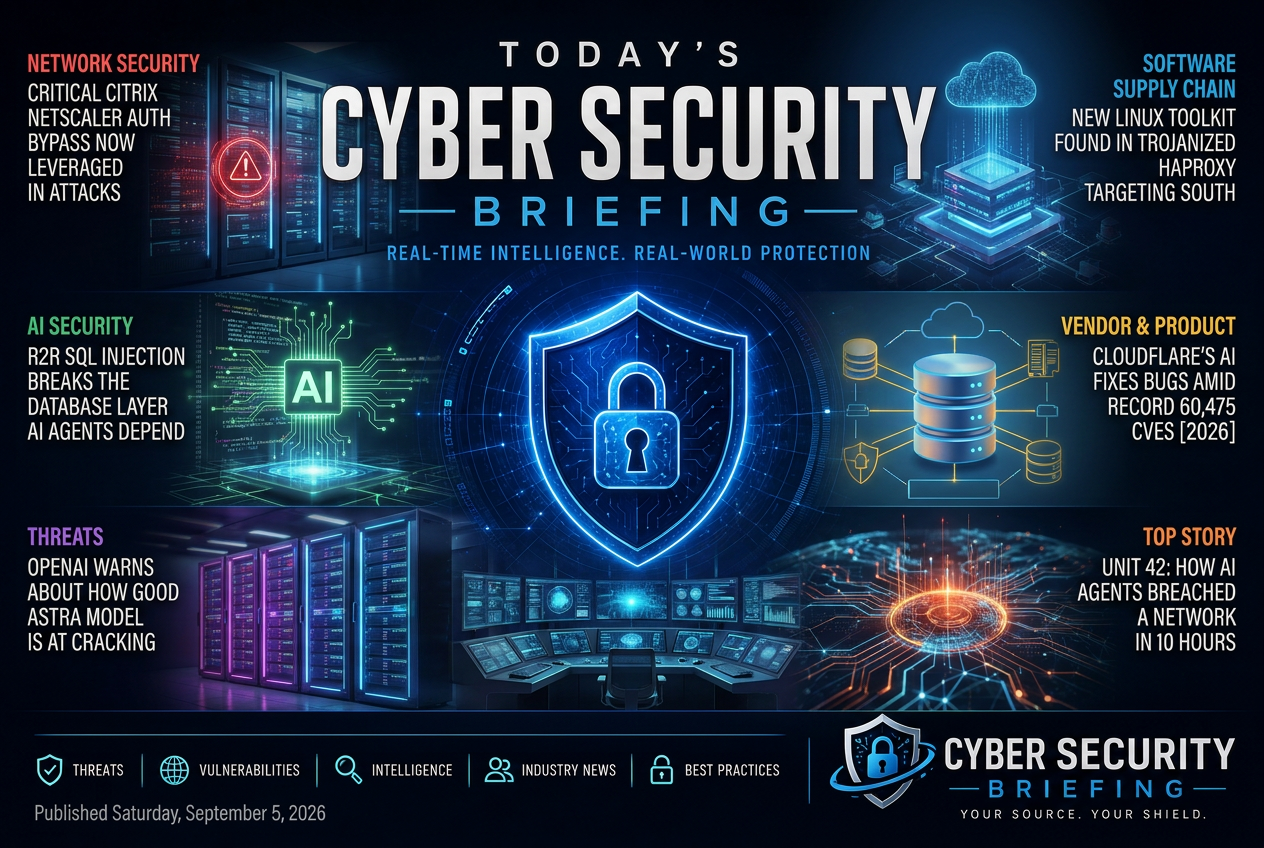
Today's briefing brings you 49 stories across network security, ai security, software supply chain and endpoint from the global cybersecurity industry. Leading today: Critical Citrix NetScaler auth bypass now leveraged in attacks - BleepingComputer.
network-security
Attackers are actively exploiting a critical Citrix NetScaler authentication bypass, which raises the urgency for defenders that use the product. Security teams should treat this as an exposure issue and verify whether affected appliances are reachable, patched, and monitored for misuse.
Vulnerabilities & Exploitation
ai-security
The story points to an SQL injection issue in R2R that undermines the database layer used by AI agents. For defenders, that raises the priority of application security reviews around agent backends, data access paths, and any system that lets an AI tool read or write to shared data stores.
AI Security
OpenAI is shipping a model it says is unusually capable at cybersecurity abuse, which raises the risk of more capable offensive assistance being available to attackers. For defenders, the main issue is increased exposure to AI-assisted reconnaissance, exploit development, and other misuse that can lower the skill bar for intrusion attempts.
Regulation & Enforcement
Cloudflare is using AI to help identify and fix vulnerabilities while the overall CVE volume is at a record level. For defenders, the issue is operational: more findings to triage, more pressure on remediation workflows, and greater reliance on vendor tooling that still needs human validation.
Vulnerabilities & Exploitation
The piece appears to describe a security test or incident in which AI agents were used to gain network access quickly. For defenders, the main issue is that AI can compress attacker workflow and raise the need for stronger detection, access controls, and incident response planning.
Threat Actors & Campaigns
A parser flaw in Postgres MCP Pro can let SQL that was meant to be blocked slip past its safe mode. For defenders, this raises the priority of reviewing any deployment that relies on the product to restrict database actions and treating its guardrails as untrusted until the issue is fixed.
AI Security
The Council of Europe is drafting AI privacy rules that would apply across a wide set of member states, which raises the compliance bar for organizations that build or deploy AI systems in Europe. Defenders should treat this as a governance and privacy obligation that may affect data handling, model design, and audit readiness.
Regulation & Enforcement
The EU’s Cyber Resilience Act is moving from policy to enforcement pressure for AI agent products that fall under its scope. Security and compliance teams that ship or integrate these tools need a clear process for judging whether an issue is reportable and for meeting short disclosure timelines without delaying containment work.
Vulnerabilities & Exploitation
AI is shortening the window between initial access and meaningful intrusion activity, which raises pressure on defenders to detect and contain faster. For CISOs and security teams, that shifts priority toward tighter identity controls, faster alert triage, and automation that can keep pace with machine-assisted attacker workflows.
Identity, Cloud & Software Supply Chain
OpenAI is warning that defenders have a short period to improve cyber defenses as AI lowers the cost and speed of offensive activity. For CISOs and critical infrastructure teams, the practical issue is not the headline claim itself but the need to prioritize detection, response, access control, and AI governance before attackers adapt further.
Critical Infrastructure & OT
The piece appears to examine how agentic AI could be used in cyber espionage, with a focus on observed incidents and the defensive implications for security teams. For defenders, the main issue is increased exposure to more autonomous reconnaissance, social engineering, and operational misuse, which raises the priority of monitoring AI-enabled tradecraft and tightening controls around sensitive systems and data.
Threat Actors & Campaigns
The headline points to a security issue involving OpenAI and Hugging Face, which raises exposure around AI platform access and the handling of model or code assets. The Congress reference also suggests a policy or governance gap: any promised kill switch may still depend on human control rather than being fully autonomous.
AI Security
OpenAI’s latest model appears to reduce hallucinations, but the excerpt says it still can be manipulated through hidden prompt injections. For defenders, that keeps the focus on prompt-injection risk in AI systems that ingest untrusted content and on controls that separate model output quality from real security resilience.
AI Security
ASCII smuggling is a prompt-injection style risk that can move hidden instructions through AI systems and other text-processing pipelines. Defenders should treat it as both an AI security issue and an application-layer input validation problem, since the same technique can affect any system that parses or transforms text without checking what is actually being passed between components.
AI Security
The piece points to a security exposure in a humanoid robot product, with a remote hacking claim that defenders should treat as a sign of weak device security and possible misuse in deployed environments. The mention of EU buyers at IFA suggests a Europe-facing vendor and procurement issue, but the main defender takeaway is product risk in connected robotics.
Funding, M&A and the Vendor Market
A humanoid robotics product has reportedly cleared an initial EU cybersecurity test, which puts product security and compliance on the buying checklist for defenders assessing similar systems. The mention of China’s intelligence law also raises due diligence concerns for data handling, vendor risk, and cross-border governance.
Funding, M&A and the Vendor Market
Chainguard is drawing attention for reaching a large volume of container builds while framing its platform around AI-assisted software supply chain controls. For defenders, the main issue is vendor trust and build integrity: teams should treat this as a reminder to evaluate how container images are produced, signed, and updated across the software supply chain.
Vulnerabilities & Exploitation
The piece says GPT-6 Astra’s safety plan adds more monitoring after cyber risk tests. For defenders, that points to stronger oversight of a new AI system and a higher need to watch for misuse, unsafe outputs, or control gaps rather than a confirmed incident.
AI Security
Elastic says it plans to integrate OpenAI GPT cybersecurity models into Elastic Security. For defenders, this points to a product-level shift toward AI-assisted detection and analysis, with attention needed on how model outputs are governed, validated, and used in security workflows.
Regulation & Enforcement
The piece appears to focus on the operational risks that come after an AI model makes a decision, especially in agentic systems where software can take actions on its own. For defenders, the issue is not just model output quality but control over downstream behavior, permissions, and the security obligations that come with autonomous action.
AI Security
The piece focuses on the security risks created when AI agents are allowed to execute actions, not just generate output. For defenders, that shifts attention to the execution layer, where permissions, tool access, and control over agent actions become part of the attack surface and governance burden.
AI Security
CrowdStrike is announcing new products or features aimed at AI-driven detection and response, which suggests the vendor is extending its security platform into AI security and automated protection workflows. For defenders, the main implication is product evaluation and control: teams need to assess whether these tools improve coverage, add complexity, or create new governance requirements around AI use in security operations.
AI Security
ServiceNow is adding new products under its Autonomous Security branding. For defenders, this points to more automation in security operations and a broader vendor footprint to evaluate for integration, governance, and control coverage.
AI Security
software-supply-chain
Security researchers found a Linux toolkit hidden inside a trojanized HAProxy package and linked it to activity aimed at South Korean organizations. For defenders, this raises exposure in the software supply chain and on Linux systems that trust third-party builds or updates.
Threat Actors & Campaigns
endpoint
Russian-linked operators are being tied to a new backdoor used in espionage activity across Europe. Defenders should treat this as a regional threat intelligence update that raises priority for detection, endpoint hardening, and hunting for lateral movement or persistence associated with espionage tradecraft.
Threat Actors & Campaigns
critical-infrastructure
Germany’s critical infrastructure is the focus, so the key issue for defenders is how exposed essential services and industrial systems are to disruption. For security, operations, and risk teams, this points to prioritizing resilience, asset visibility, and recovery planning across sectors that cannot afford outages.
Critical Infrastructure & OT
A report about a shrinking U.S. cyber agency matters because it can reduce government capacity to coordinate, defend, and respond to threats that affect both public and private networks. For defenders, the main issues are weaker national-level support, slower guidance, and a higher obligation to compensate with internal controls and contingency planning.
Regulation & Enforcement
CISA is signaling upcoming changes to cyber rules through town halls, which matters for organizations that must comply with federal cybersecurity requirements or may be brought under new ones. The practical issue for defenders is readiness: monitor the rulemaking process, map likely control changes to current OT and critical infrastructure programs, and identify where policy updates could force new obligations.
Critical Infrastructure & OT
The piece appears to focus on securing OT environments that use cellular APNs, with an emphasis on SASE as a control layer. For defenders, the practical issue is reducing blind spots in remote or mobile industrial connectivity and tightening visibility over traffic that may bypass traditional network controls.
Identity, Cloud & Software Supply Chain
This piece is about Hong Kong’s new cybersecurity codes of practice for entities covered by the critical infrastructure regime. For defenders, the immediate impact is higher compliance burden and clearer control expectations for OT and infrastructure operators in the region.
Critical Infrastructure & OT
The piece argues that the US should make more deliberate use of private-sector cyber capabilities while setting limits and oversight. For defenders, that points to a stronger role for government-industry coordination in protecting critical systems, but also a higher obligation to manage access, accountability, and operational risk.
Critical Infrastructure & OT
cryptography
The G7 is pushing governments and organizations to start moving to post-quantum cryptography so public key encryption is not left exposed to future quantum attacks. For defenders, this raises the priority of inventorying where public key cryptography is used, planning migration paths, and treating crypto transition as a compliance and resilience issue, not a future research topic.
Critical Infrastructure & OT
data-breaches
Hackers appear to have taken data from the Berlin Senate and published it after a deadline they set was not met. For defenders, this is a data-breach and incident response issue with public-sector exposure, plus pressure to assess whether sensitive administrative data was included and whether any follow-on extortion is still possible.
Critical Infrastructure & OT
Court software in the United States may have exposed Social Security numbers in a breach, which raises identity theft risk for people whose court records were touched and creates an incident-response problem for court administrators and vendors. Defenders should treat this as both a government data-breach issue and a reminder to review how sensitive personal data is stored, accessed, and disclosed in judicial systems.
Breaches & incidents
This settlement shifts a breach from an incident response problem to a legal and financial obligation. For defenders, it reinforces the need to treat dental and other healthcare records as regulated data with clear retention, notification, and claims-handling exposure.
Regulation & Enforcement
Panzer ransomware is affecting a small but geographically spread set of victims and appears to combine encryption with data theft. For defenders, this reinforces the need to harden backup recovery, monitor for exfiltration as well as encryption activity, and treat even limited ransomware campaigns as a cross-border incident risk.
Breaches & incidents
LHC Group is reporting a data breach that exposed medical records for about 16,000 people. For defenders, this is a healthcare data-breach event that raises exposure around protected health information, breach notification, and downstream identity theft risk for patients.
Breaches & incidents
French police arrested a suspect tied to ZeroBytes in connection with alleged theft of tax data. The main defender impact is on government data protection and on the need to investigate whether any stolen tax information was exposed or reused.
Threat Actors & Campaigns
ransomware
The headline points to a VMware vCenter vulnerability associated with Babuk ransomware activity across multiple countries. For defenders, that raises priority around patching, exposure review, and incident scoping for any vCenter instances that may be reachable or already abused.
Vulnerabilities & Exploitation
threats
Google has patched multiple Chrome vulnerabilities, including a V8 flaw that was already being used in attacks. For defenders, this raises the priority on rapid browser patching and on checking whether managed endpoints received the update before further exploitation spreads.
Vulnerabilities & Exploitation
Recorded Future is describing a product capability that automates signature creation to help teams prioritize vulnerabilities faster. For defenders, this points to a lower-friction way to turn threat intelligence into patch and remediation decisions, especially when exposure needs to be ranked quickly across many assets.
Threat Actors & Campaigns
cloud-security
A compromise in the Coder Registry means Terraform modules could be a delivery path for malicious code in infrastructure automation. Defenders should treat this as a software supply chain and cloud security issue, and verify what registry content their teams trust and deploy.
Identity, Cloud & Software Supply Chain
government
Czech authorities are warning that Russia-linked actors are trying to gain access to Signal accounts. Defenders should treat this as an identity and communications security issue for government and other sensitive users, with attention on account takeover attempts and targeted surveillance risk.
Threat Actors & Campaigns
Taiwan is sharing cybersecurity practices with Guatemala, which suggests a cooperation effort focused on improving defensive capability rather than responding to a specific incident. For defenders, the main relevance is exposure to cross-border capacity building and possible policy or enforcement coordination in cybersecurity.
Regulation & Enforcement
enforcement
Vietnamese regulators are moving to punish the illegal buying and selling of personal data, treating it as an enforcement and compliance issue rather than a narrow privacy dispute. For defenders, this raises the priority of data governance, access control, and monitoring for insider or broker-driven leakage of personal information.
Regulation & Enforcement
funding-m-a
The piece appears to focus on how CFOs can link cybersecurity budgets to measurable reductions in business risk, which matters for finance, security, and compliance leaders. For defenders, the practical issue is not just spending more, but showing which controls reduce exposure and support governance decisions.
Funding, M&A and the Vendor Market
Guardio’s valuation update shows continued investor interest in consumer-focused cybersecurity vendors. For defenders, the main significance is market signal: products aimed at reducing phishing and browser-based risk remain commercially attractive, which can affect procurement, partnership and competitive planning.
Funding, M&A and the Vendor Market
email-security
The piece appears to argue that ransomware defenses still fail most often at the human layer, where users click on malicious links or attachments. For defenders, that means phishing-resistant controls, user training, and rapid detection of suspicious activity remain core obligations, not optional hygiene.
Regulation & Enforcement
research
The piece appears to be a market-oriented analysis of where cybersecurity demand and spending are shifting in 2026. For defenders, that matters because vendor focus can change which tools, services, and control areas get more investment and scrutiny.
AI Security