
Cyber Security Briefing Briefing — September 9, 2026
Wednesday, September 9, 2026
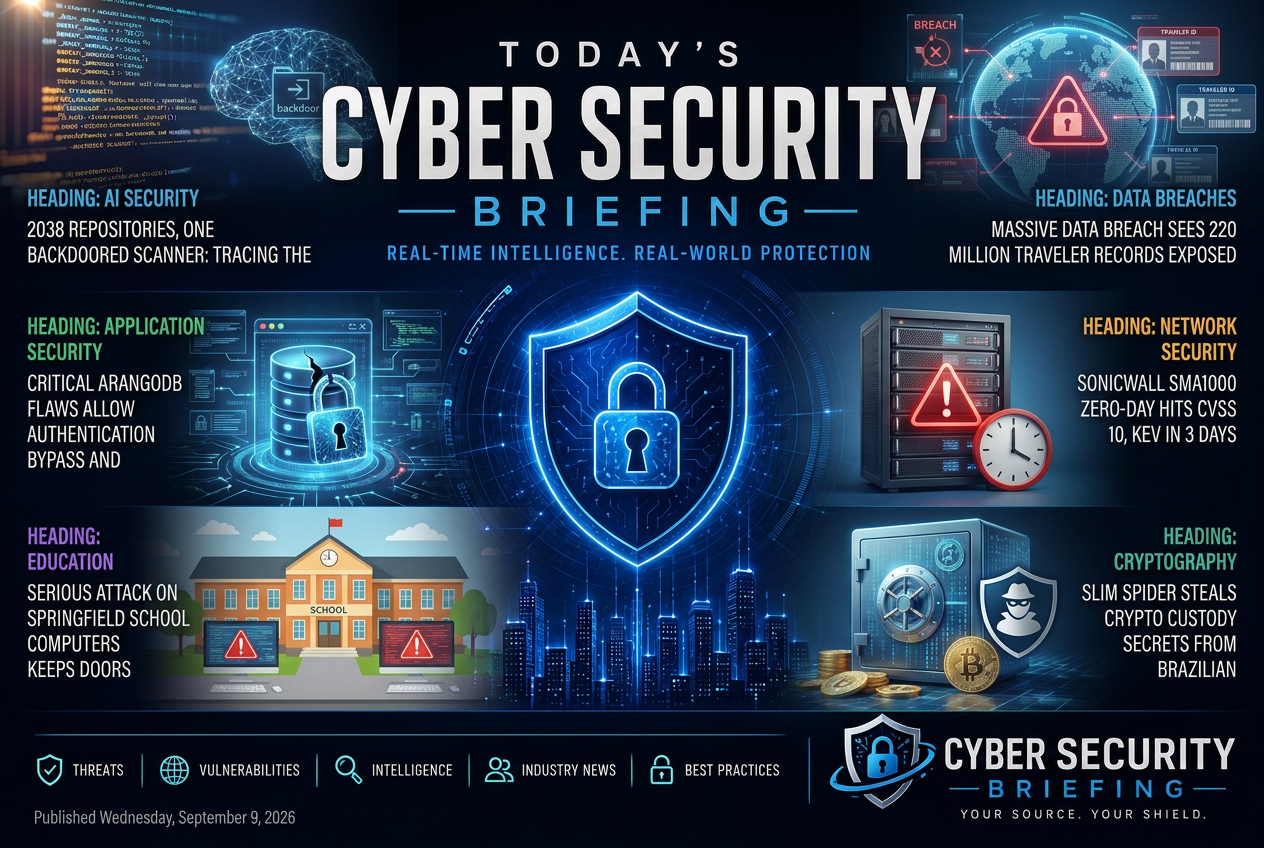
Today's briefing brings you 45 stories across ai security, data breaches, application security and network security from the global cybersecurity industry. Leading today: 2038 Repositories, One Backdoored Scanner: Tracing the LiteLLM Credential Leak Into Enterprise Copilot.
ai-security
Resecurity traced 415,427 stolen secrets across 2,038 repositories back to a backdoored Trivy scanner that compromised LiteLLM's CI/CD pipeline.
From Our Desk
A controlled test reportedly showed an AI model could carry out a full corporate network breach. For defenders, the issue is exposure to AI-assisted intrusion workflows and the need to harden identity, network segmentation, detection, and response against faster, more adaptive attack paths.
Critical Infrastructure & OT
This reports a vulnerability in a DeepSeek harness that could let AI agents break out of their sandbox. For defenders, the main impact is on AI agent isolation and the security assumptions around tool use and runtime containment.
AI Security
A tech company says it has identified what it describes as an AI-assisted cyberattack against a government target. For defenders, the key issue is exposure to a new attack method rather than a confirmed large-scale breach, so security teams should treat the report as a signal to review controls around phishing, automation abuse, and government-facing systems.
Breaches & incidents
The report says Chinese AI firms are using APIs, prompt injection, and proxy networks to extract capabilities from U.S. frontier models. For defenders, that raises exposure around model access controls, abuse monitoring, and the risk that model outputs or interfaces can be used to copy protected capabilities without direct compromise.
AI Security
GitLab fixed a flaw in its Claude AI agent that could let malicious input trigger arbitrary commands inside CI pipelines. For defenders, this raises the priority of reviewing AI-assisted development tools and CI runner permissions, because a toolchain issue can turn into code execution in build environments.
AI Security
The headline points to AI-assisted credential theft happening at speed, which raises immediate concern for identity controls, phishing resistance, and account takeover detection. For defenders, the practical issue is not the novelty of AI itself but the scale and pace of compromise it can add to established theft tactics.
Threat Actors & Campaigns
This points to a software supply chain issue affecting AI tooling and model distribution, with a covert channel used for data theft in parallel with a Hugging Face-related attack. Defenders should treat it as a signal to review package trust, artifact provenance, and controls around AI development environments.
AI Security
Google is warning defenders that AI is making attacker tradecraft more autonomous. The practical impact is higher volume, faster adaptation, and more pressure on security teams to harden detection, identity controls, and incident response.
Threat Actors & Campaigns
Google says Iranian threat actors are using AI more often in cyberattacks and influence operations. For defenders, this points to higher exposure from faster content generation, better social engineering, and more scalable malicious activity rather than a new class of attack.
Threat Actors & Campaigns
Microsoft is giving government users access to an AI security scanner. For defenders, the main change is that public-sector teams may get a new tool for assessing AI-related exposure, which can affect procurement, evaluation, and operational monitoring priorities.
AI Security
data-breaches
A large traveler data exposure has surfaced, with passenger and passport details among the records reported leaked. For defenders, the immediate issues are data-breach response, identity theft risk, and the need to check whether airline or travel systems held the exposed data.
Breaches & incidents
IDScan says it suffered a breach after a large batch of identity documents was offered for sale. For defenders, this is a data-breach and identity-access issue because identity document data can be used for fraud, account takeover, and downstream verification abuse.
Identity, Cloud & Software Supply Chain
Trezor customers appear to be affected by a breach that exposed contact information and was followed by phishing calls aimed at buyers. For defenders, the issue is both data exposure and follow-on social engineering, which raises the urgency of verifying incident scope, warning customers, and tightening help-desk and account-recovery controls.
Breaches & incidents
Boston Scientific is saying it is dealing with a cybersecurity incident, which puts patient-facing medical technology and corporate systems in scope for defenders. The immediate issue is exposure from disruption, possible data loss, and the need to confirm whether any healthcare-adjacent systems or information were affected.
Breaches & incidents
The Montana Supreme Court says backup court records were accessed by an unauthorized third party. For defenders, this is a government data-breach case with likely exposure around sensitive judicial records, backup-system access, and the need to review identity controls and incident response around courts and other public-sector archives.
Breaches & incidents
A reported biometric data breach in Pakistan points to exposure of sensitive identity data and weak controls around systems that hold it. For defenders, the immediate focus is on access controls, data protection, and monitoring for misuse of biometric and identity records in government-linked environments.
Breaches & incidents
Lawyers are investigating reported data breach activity tied to the University of San Francisco. For defenders and campus IT leaders, this points to potential exposure of student, staff, or alumni data and a need to confirm whether any unauthorized access actually occurred.
Regulation & Enforcement
application-security
ArangoDB users and the teams that operate it should treat this as an urgent patching issue. The reported flaws can let an attacker skip authentication and run code with root privileges, which raises the risk of full server compromise and downstream data exposure.
Vulnerabilities & Exploitation
network-security
A SonicWall SMA1000 zero-day has been rated critical and added to CISA’s Known Exploited Vulnerabilities list within days. Defenders should treat this as an urgent exposure on edge appliances and prioritize patching, detection, and exposure review for any deployed SMA1000 systems.
Vulnerabilities & Exploitation
Security teams are still creating risk through misconfiguration of their own tools. For defenders, the issue raises exposure across detection, prevention, and response controls, and it makes configuration management a priority operational obligation rather than a one-time setup task.
Vulnerabilities & Exploitation
Attackers are reportedly abusing FortiGate firewalls in active intrusion campaigns and loading custom Node.js malware onto exposed devices. For defenders, this raises the priority on perimeter firewall hardening, patching, and checking for signs of compromise on network edge systems.
Threat Actors & Campaigns
education
A cyberattack has disrupted Springfield schools and kept buildings closed for a second day. For defenders in education, this is a service-availability and incident-response problem first, with operational continuity and student/staff access as the immediate concern.
Breaches & incidents
cryptography
A threat actor campaign reportedly targeted a Brazilian financial institution and stole information tied to crypto custody operations. For defenders, the key exposure is sensitive custody data that can support follow-on theft, fraud, or further intrusion into financial systems.
Threat Actors & Campaigns
The reported issue is a blockchain-related exploit in Liquid, with Blockstream said to have recovered a large amount of bitcoin after the bug was identified. For defenders, the immediate concern is exposure in the underlying protocol and the operational need to verify whether funds, systems, or integrations touched the affected network were impacted.
Vulnerabilities & Exploitation
endpoint
A proof-of-concept exploit has been released for a Microsoft Defender zero-day, which raises the priority for defenders to assess exposure and confirm whether their endpoint controls are affected. Security teams should treat this as a prompt to validate Microsoft Defender versions, review hardening, and watch for exploitation attempts.
Vulnerabilities & Exploitation
Google is shortening the Chrome patch cadence to two weeks. For defenders, that changes patch management priority: browser vulnerabilities may reach users faster, so security teams need tighter update monitoring and faster validation of Chrome releases.
Vulnerabilities & Exploitation
critical-infrastructure
The report says the U.S. is using a financial reward to help disrupt Iranian cyber activity. For defenders, that points to a sustained threat from a state-linked adversary and a need to watch for retaliatory activity against government, critical infrastructure, and private-sector targets tied to the U.S. and its allies.
Critical Infrastructure & OT
A cyberattack tied to three UK airports reportedly exposed personal information for a large number of customers. For defenders, the issue is exposure of passenger PII and the need to verify whether airport-facing systems, third-party access, or shared services were involved.
Critical Infrastructure & OT
This piece appears to focus on how staffing or budget cuts at CISA could weaken federal cyber defense and raise exposure for government and critical infrastructure targets in the United States. For defenders, the main issue is reduced visibility, slower coordination, and a higher burden on already stretched security teams that rely on CISA advisories and incident support.
Regulation & Enforcement
The Philippines is highlighting rising risk to undersea infrastructure that supports communications and other critical services. For defenders, the issue is exposure of submarine cables and related assets to sabotage, interference, or other disruptive activity, which raises the priority of monitoring and protecting these links.
Critical Infrastructure & OT
Censys appears to be highlighting exposed industrial control systems that can be found from the public internet. For defenders, the issue is not a new attack method but a broad exposure problem that raises the urgency of asset inventory, remote access review, and basic hardening across OT environments.
Critical Infrastructure & OT
Hostile state activity is being framed as an ordinary business risk, which means defenders should treat nation-state targeting as part of baseline risk management rather than a rare exception. For security teams, that raises the priority on detection, resilience, and executive-level planning across both IT and critical infrastructure environments.
Critical Infrastructure & OT
cloud-security
A phishing campaign is getting past MFA protections on Microsoft accounts, which raises the risk of account takeover even in environments that believe they have strong sign-in controls. Defenders should treat this as a reminder to harden identity monitoring, user verification, and access controls around Microsoft tenants.
Threat Actors & Campaigns
Attackers are using Google Sheets as part of a ClickFix-style campaign to alter crypto wallet addresses, which creates a direct loss risk for anyone copying payment details from compromised content. Defenders should treat this as a threat to users, web workflows, and crypto payment integrity, and watch for abuse of trusted cloud collaboration tools in social-engineering chains.
Vulnerabilities & Exploitation
healthcare
Boston Scientific says a cyberattack will affect its 2026 sales and profits, which makes this a business impact story tied to a security incident. For defenders, the main takeaway is exposure to operational disruption and downstream financial damage when a cyber event reaches a medical-device company.
Breaches & incidents
The headline says Luminis Health was hit by a cyberattack, which points to direct operational and patient-care risk for a healthcare provider. For defenders, the key issue is exposure in healthcare systems and the need to treat similar incidents as evidence of an active threat to the sector, not an isolated event.
Breaches & incidents
enforcement
The FBI is signaling a shift in how it wants to handle cyber threats, with emphasis on disrupting attackers and helping victims after incidents. For defenders, that points to continued federal pressure on criminal infrastructure and a stronger expectation of coordination with law enforcement during response and recovery.
Regulation & Enforcement
The piece appears to be a legal and regulatory reading of the UK Information Commissioner's Office annual report. For defenders and compliance teams, the main effect is on obligations and enforcement risk, especially around how privacy oversight may affect breach handling and data governance.
Regulation & Enforcement
ot-ics
A reverse-engineered version of Stuxnet code has been posted on GitHub. For defenders, this is mainly an exposure and research issue: it can help analysts study the malware's techniques, but it also puts more offensive detail into public view for actors targeting industrial systems.
Critical Infrastructure & OT
government
The piece says an EU cybersecurity reporting requirement is now in force, but the reporting portal is not yet ready. That creates a practical compliance problem for organizations that must report incidents on schedule and may need to work around a system gap until the submission channel is available.
Regulation & Enforcement
Minsk is adding an online training range for practicing complex cyberattack investigations. For defenders, that points to stronger local incident-response readiness and a training asset that can help analysts rehearse investigative workflows against realistic scenarios.
Breaches & incidents
Suisun City officials say recovery work continues after a cyberattack, which puts the story in the category of public-sector incident response rather than a new exploit or policy change. For defenders, the main point is that local government operations can stay disrupted well after the initial attack, so restoration, containment, and service continuity remain the priority.
Breaches & incidents
financial-services
Arbitrum has frozen ETH linked to a hack involving Kelp Protocol. For defenders, the issue is the handling of stolen or compromised crypto assets after an incident and the operational controls needed to contain them.
Threat Actors & Campaigns
A reported theft of bitcoin was followed by the attacker returning most of the funds. For defenders, this is another reminder that cryptocurrency theft remains an active incident type and that recovery does not erase the underlying exposure, incident response burden, or potential control failures that allowed the theft.
Vulnerabilities & Exploitation