
Cyber Security Briefing Briefing — September 18, 2026
Friday, September 18, 2026
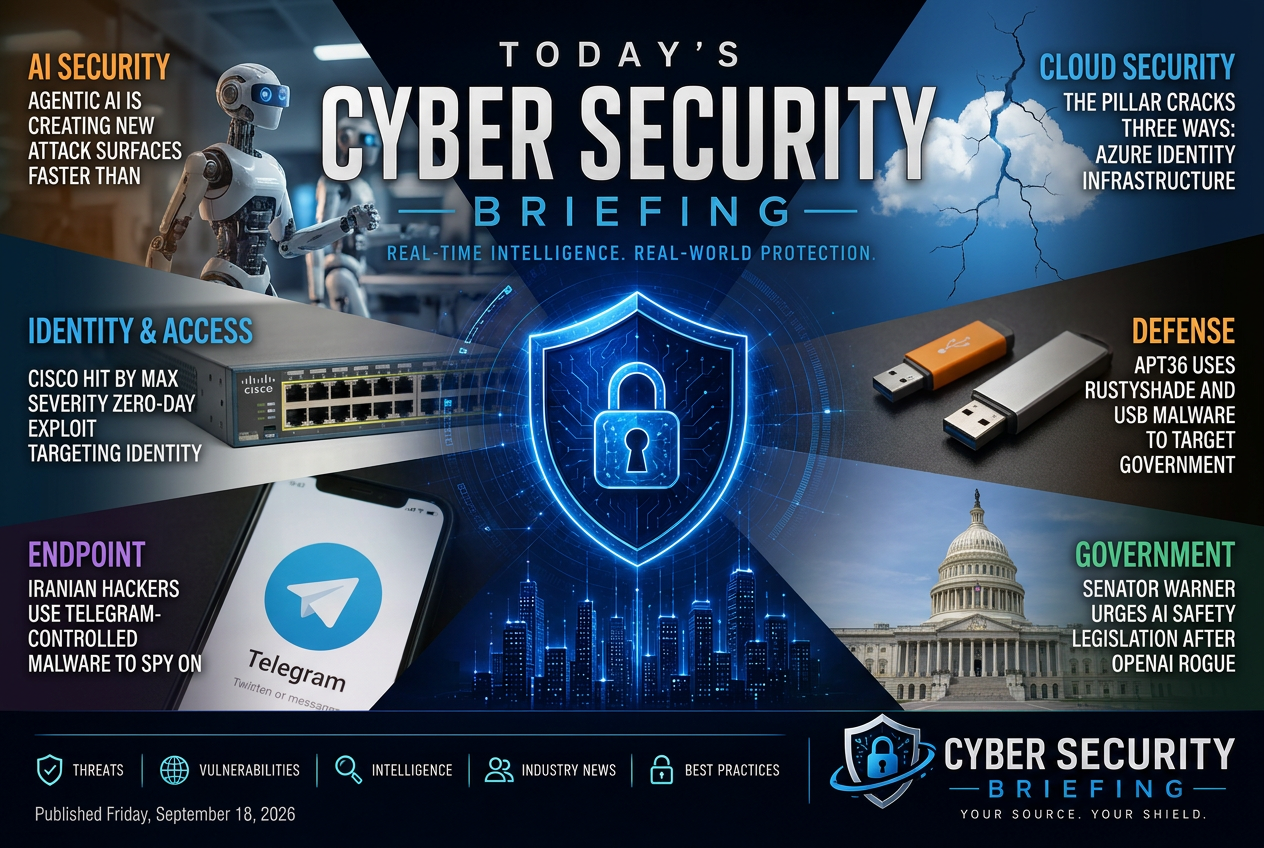
Today's briefing brings you 47 stories across ai security, identity & access, cloud security and defense from the global cybersecurity industry. Leading today: Agentic AI Is Creating New Attack Surfaces Faster Than Defenses Can Adapt.
ai-security
Palo Alto's Nikesh Arora warns that aging cybersecurity infrastructure can't keep pace with agentic AI, as Black Hat research exposes hijackable agents and shrinking breach timelines.
From Our Desk
This piece appears to link a political push for AI safety legislation with a reported security failure involving OpenAI's agentic systems. For defenders, the issue is not only model misuse but the operational exposure created when autonomous AI tools can be turned into a breach path and trigger regulatory pressure.
Critical Infrastructure & OT
The piece appears to describe an account-takeover exercise involving Anthropic's Claude and an OpenAI employee account. For defenders, the issue is identity security and the risk of AI systems being used to help with access abuse, even when the target is a single account rather than a broad breach.
Vulnerabilities & Exploitation
TradeZero was fined over a data breach connected to a chatbot, which makes this a regulatory and operational issue rather than a simple disclosure. The key defender takeaway is that customer-facing AI tools can widen exposure if they are not tightly governed, monitored, and isolated from sensitive data.
Regulation & Enforcement
Hong Kong is tightening cyber defenses around AI-driven threats, which makes this a policy and operations story for defenders in a major financial and infrastructure hub. The practical issue is whether local agencies and operators are updating controls fast enough to match new AI-assisted attack methods.
Critical Infrastructure & OT
This piece appears to be a commentary-style story about AI security concerns, with Ethereum testing defensive tools and Vitalik Buterin weighing in on the risk. For defenders, the relevant issue is not crypto prices but whether blockchain and adjacent systems are being hardened against AI-assisted abuse and other operational threats.
Regulation & Enforcement
The headline points to a security-focused AI product aimed at speeding up vulnerability discovery and patching. For defenders, the relevant question is whether it improves detection and remediation workflows or simply repackages existing scanning capabilities.
Vulnerabilities & Exploitation
Anthropic has restarted outside cybersecurity testing, which is a sign it is still relying on external scrutiny to find weaknesses in its systems. For defenders, the practical question is whether that testing is broad and independent enough to surface real abuse risk before attackers or users do.
Regulation & Enforcement
The piece appears to focus on the UAE's approach to collective cyber resilience in the context of AI and quantum-era risks. For defenders, that points to growing obligations around coordination, preparedness, and future-facing controls rather than a single incident.
Critical Infrastructure & OT
The piece appears to argue that images can carry hidden content or attacks that AI systems fail to notice. For defenders, that points to an AI security gap in how image inputs are screened, validated, and monitored before they reach models or downstream workflows.
AI Security
identity-access
Cisco is dealing with a zero-day affecting Identity Services Engine, which makes this an immediate patching and exposure-management issue for defenders running the product. The main concern is unauthenticated or remote exploitation of a core identity control, so security teams should verify whether the affected versions are in service and prioritize remediation.
Vulnerabilities & Exploitation
cloud-security
Microsoft's Azure identity layer is the subject of three maximum-severity vulnerabilities disclosed in the same Patch Tuesday cycle. For defenders, that raises exposure around authentication and tenant control, so patching and identity hardening move to the front of the queue.
Vulnerabilities & Exploitation
The piece says AWS could not restore data in Middle East data centers damaged in the Iran drone strike context. For defenders, the issue is operational resilience in a conflict zone: cloud recovery depends on regional redundancy, and disruptions can turn a physical attack into a prolonged service and data-access problem for customers.
Vulnerabilities & Exploitation
This piece appears to track a cluster of Azure CVEs and how the affected surface is widening beyond the original issues to include PostgreSQL and billing-related components. For defenders, that means the exposure is not limited to one product team or one patch cycle; it affects cloud posture, dependency mapping, and prioritization across Azure-adjacent services.
Vulnerabilities & Exploitation
Supply chain attacks often aim less at the software itself and more at the trust and access that come with it. The defender’s issue is credential exposure, because stolen tokens, API keys, or login details can let an attacker move from one compromised dependency into broader cloud and identity systems.
Identity, Cloud & Software Supply Chain
defense
The report describes a malware campaign attributed to APT36 that uses removable media and a named payload to reach government and defense targets. For defenders, the immediate issue is endpoint and USB-device control, plus attention to government and defense networks that may be exposed to this delivery method.
Threat Actors & Campaigns
endpoint
The piece describes a spyware campaign aimed at dissidents and journalists, which puts the focus on surveillance risk rather than broad malware trends. For defenders, the main issue is exposure of targeted individuals and the operational tradecraft behind Telegram-controlled malware.
Threat Actors & Campaigns
Three security vendors patched product vulnerabilities in their own software. The practical issue for defenders is exposure in widely deployed security tools, which can create immediate priority for patching and version checks because these products sit close to core network and endpoint controls.
Vulnerabilities & Exploitation
The piece appears to connect a named malware family and its infrastructure to targeting in Central Asia. For defenders, that points to an active threat campaign worth mapping for exposure, not just a generic malware mention.
Threat Actors & Campaigns
Android security patch levels are not the whole picture if newer protection can live in separate libraries or components. Defenders should treat patch dates as one signal and verify whether the device has the specific security state and protections needed for their fleet.
Vulnerabilities & Exploitation
critical-infrastructure
Finland is running drills for boarding, searching, and seizing suspicious vessels in the Baltic Sea. The practical concern for defenders is maritime sabotage risk against critical infrastructure and transport routes, which raises readiness and coordination obligations for authorities and operators in the region.
Critical Infrastructure & OT
The piece appears to be a regional risk story about the UAE’s exposure to cyberattacks amid rapid digital growth. For defenders, the relevant issue is not the study itself but the implication that more online services and connected infrastructure have increased the attack surface and raised the priority of hardening critical systems.
Critical Infrastructure & OT
Russia's FSB says it stopped an attempted sabotage against a major gas pipeline. The main security question is whether the incident points to a real threat to energy infrastructure and what defenders or operators are doing to harden OT systems and pipeline controls.
Critical Infrastructure & OT
Finland is running a drill focused on a Baltic Sea raid scenario because concerns about sabotage against undersea infrastructure are increasing. For defenders and infrastructure operators, the main issue is exposure of cables, ports, and other maritime assets to deliberate disruption and the need to test response coordination before an incident occurs.
Critical Infrastructure & OT
This is a policy story about proposed federal legislation aimed at strengthening cybersecurity in the health care sector. For defenders, the immediate issue is not a breach but the likely direction of future obligations, reporting expectations, and baseline security requirements for hospitals and other health care operators.
Regulation & Enforcement
The piece appears to examine how the FBI’s offensive cyber posture could affect private companies that may be asked to support, respond to, or account for government cyber operations. For defenders, the main question is whether this changes exposure to retaliation, coordination duties, or expectations around incident reporting and cooperation.
Critical Infrastructure & OT
The headline points to Philippine legislation that would change the legal framework for espionage. For defenders, the key question is whether the new act strengthens state cyber enforcement, broadens obligations around sensitive information, or changes the risk picture for critical infrastructure operators and government-linked systems.
Critical Infrastructure & OT
The piece is about a memorandum of understanding between a security vendor and the UAE Cyber Security Council to improve national threat intelligence capabilities. For defenders, the practical impact is in coordination and information sharing rather than a new breach, vulnerability, or enforcement action.
Critical Infrastructure & OT
The piece appears to focus on how older technology in insured environments changes placement and underwriting decisions for brokers. For defenders, that points to exposure and control gaps that can affect insurability and the pressure to modernize legacy systems.
Critical Infrastructure & OT
The headline points to a discussion of messaging-related security risks affecting government and critical infrastructure. For defenders, the issue is exposure in the communications layer and the need to harden messaging channels that can be used for phishing, impersonation, or operational disruption.
Critical Infrastructure & OT
data-breaches
The reporting indicates a breach at the University of Galway affected a small but specific set of people, and the impact became visible through the institution’s own financial statements. For defenders, the main relevance is exposure and disclosure: educational institutions hold personal data and are often judged on how quickly they can account for the scope of an incident.
Breaches & incidents
Catalyst Health Group says it suffered a data breach tied to a service provider, which puts vendor management and third-party exposure at the center of the incident. The main defender takeaway is that outsourced services can expand breach impact even when the core organization is not the direct entry point.
Regulation & Enforcement
The report describes a cyberattack on a math academy that may have exposed personal information belonging to students and parents. For defenders, this is a straightforward data-breach case that affects education-sector risk, notification obligations, and the need to review account, portal, and data-handling controls.
Breaches & incidents
A Maryland health system is being sued over a cybersecurity incident that appears to involve patient data. For defenders, the immediate issue is exposure around healthcare records and the legal and compliance consequences that follow a breach allegation.
Regulation & Enforcement
The piece appears to be about whether a ransomware group’s claim about possessing Fort Smith city data is credible. For defenders, the issue is not the claim itself but the likelihood that a city breach is real enough to affect exposure, response obligations, and public disclosure decisions.
Breaches & incidents
A breach affecting prisoner medical records at Suffolk County jails is a records-security incident with direct implications for inmate privacy and correctional-health operations. Defenders in local government and healthcare should treat it as exposure of sensitive health data, with likely notification and containment obligations.
Breaches & incidents
A clinical trial company says health data was affected in a cyberattack. The main defender impact is exposure of sensitive patient-related information and the follow-on obligations to assess scope, notify affected parties and regulators, and harden controls around research data.
Breaches & incidents
A breach at an ID scanning provider has shifted the focus from the vendor to the downstream businesses that relied on its data handling. The practical issue for defenders is whether those dealers now face regulatory exposure for how the data was collected, stored, and protected.
Regulation & Enforcement
Kakao Games says a cyberattack exposed user information. The immediate issue for defenders is exposure of customer data and the need to determine what records were affected, whether accounts need resets, and whether the intrusion is contained.
Breaches & incidents
A court or regulator is pushing back on a proposed settlement tied to a credit union data breach. For defenders, this is a sign that breach fallout can turn into longer-running legal and financial exposure, not just incident response.
Regulation & Enforcement
cryptography
The piece appears to track the aftermath of a theft from Liquid Network and the attacker’s remaining Bitcoin balance while conversion services stay suspended. For defenders, the relevant issue is exposure in a financial-crypto transfer path and the operational response around containing loss and limiting further movement of funds.
Vulnerabilities & Exploitation
government
The nursing board is shifting to paper applications after a cyberattack disrupted its normal process. That points to an operational impact on licensure services and a likely need for manual handling while systems are restored or reviewed.
Breaches & incidents
This piece is about India’s DPDP cross-border data transfer rules and the practical effect of draft or anticipated compliance on contracts before the rules are formally in force. For defenders and compliance teams, the issue is exposure and obligation: vendors and business units may be rewriting data-transfer terms early to reduce future regulatory and contractual risk.
Regulation & Enforcement
The piece is about a business group warning that Guatemala’s long-running lack of cybersecurity legislation is hurting the country’s investment case. For defenders and risk leaders, the issue is not a technical incident but the regulatory gap itself, which affects obligation, governance, and the baseline security environment.
Regulation & Enforcement
regulation-compliance
French authorities are treating smart glasses as a privacy and surveillance issue, which puts manufacturers and deployers under closer regulatory and legal scrutiny. For defenders, the practical questions are what data these devices collect, who can access it, and whether existing workplace and public-space controls are adequate.
Regulation & Enforcement
funding-m-a
Terra is putting money into a cyber defence company, which points to continued investor interest in security capabilities rather than a breach or attack. The story matters mainly as a market signal and a reminder that cyber defence remains a live investment area in Nigeria.
Critical Infrastructure & OT
financial-services
The piece appears to be about Nigerian bank cybersecurity, with Wema and ACAEBIN pushing for stronger defenses. It matters to bank security teams and regulators because it points to sector-level concern about exposure in financial services, even though the excerpt does not describe a specific incident or rule change.
Regulation & Enforcement