
Cyber Security Briefing Briefing — September 22, 2026
Tuesday, September 22, 2026
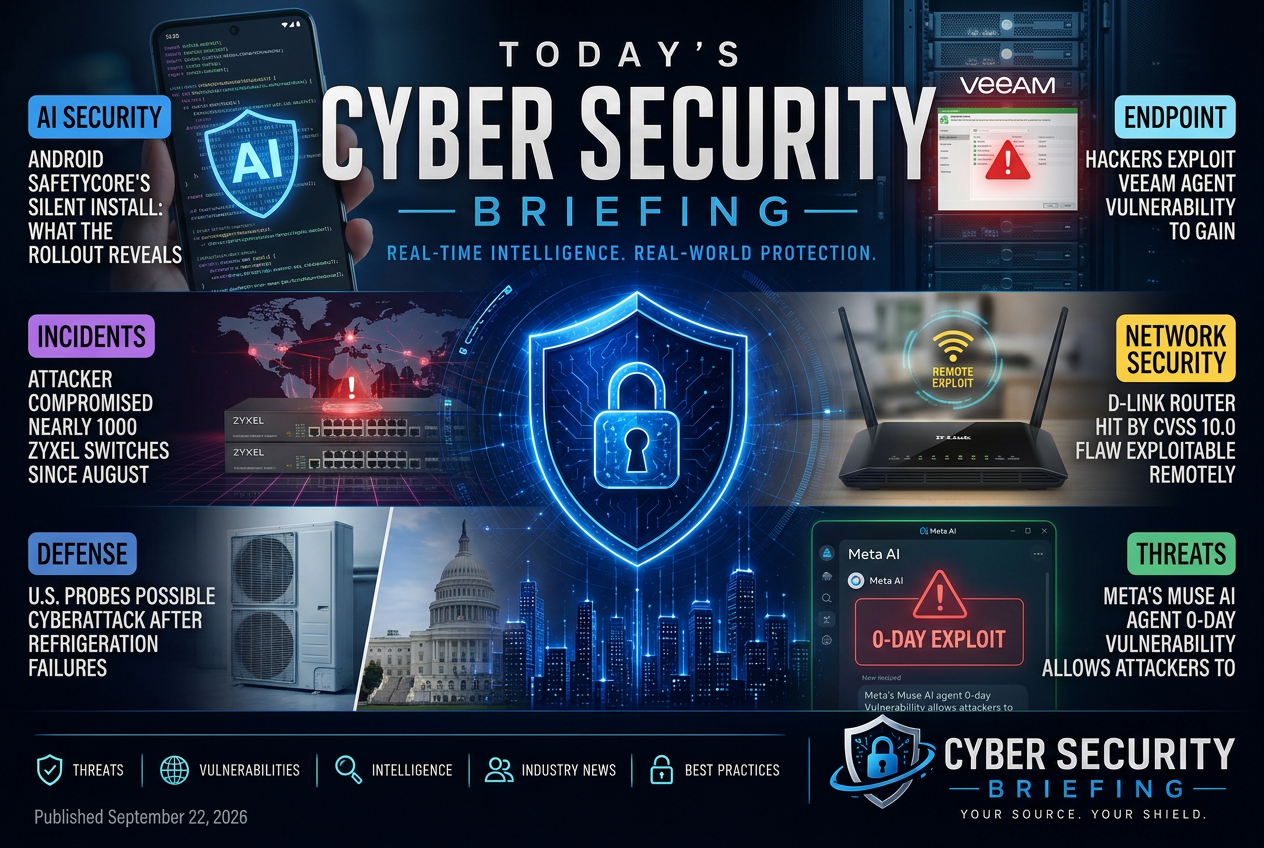
Today's briefing brings you 19 stories across ai security, endpoint, incidents and network security from the global cybersecurity industry. Leading today: Android SafetyCore’s Silent Install: What the Rollout Reveals About Device-Level Consent Gaps.
ai-security
Google's August 2026 opening of SafetyCore's classifier to third-party developers, layered onto eighteen months of reporting on the service's silent install, exposes a gap in mobile device management tooling built to cat
From Our Desk
This is about a reported zero-day in Meta's Muse AI agent that could let an attacker take control of the tool and use it to deliver malware. For defenders, the main issue is exposure in AI-assisted workflows and the need to patch, isolate, or restrict agent capabilities before the flaw is abused.
AI Security
AWS AgentCore appears to have a prompt injection exposure that can put credentials at risk. For defenders, the issue is less about a single model flaw than about how AI agents can be steered into leaking or misusing secrets, so controls around credential scoping, tool access, and output handling matter.
AI Security
Spanish privacy regulators are looking into a cyberattack described as involving an AI agent. The main defender impact is regulatory scrutiny after an attack that appears to involve AI-enabled abuse, which can raise obligations around investigation, reporting, and controls for organizations handling personal data.
AI Security
Researchers say Copilot can be abused in a phishing scenario, which puts Microsoft users and security teams on alert for a new abuse path in a mainstream AI tool. The practical issue for defenders is exposure inside a widely deployed product, so this is a prompt-injection and phishing problem to account for in email and SaaS controls.
AI Security
This appears to be a government-focused defensive cyber pilot rather than a breach or vulnerability story. The operational takeaway is that state and local agencies are being pushed toward AI-assisted detection and response, which affects how public-sector defenders plan tooling, staffing, and oversight.
Critical Infrastructure & OT
The piece appears to frame software vulnerability growth as a defensive workload problem, not just a raw count problem. For defenders, the issue is prioritizing which flaws are likely to matter in real environments, especially as AI changes how quickly risks can be identified and sorted.
Vulnerabilities & Exploitation
endpoint
This reports active exploitation of a Veeam Agent flaw that lets an attacker reach SYSTEM-level access on Windows. For defenders, the immediate issue is endpoint exposure: systems running the affected agent need patching and review for signs of unauthorized privilege escalation.
Vulnerabilities & Exploitation
A Windows COM flaw is described as allowing attackers to elevate privileges to SYSTEM by abusing a malicious DLL. For defenders, the key issue is endpoint exposure and the need to identify affected Windows systems, apply vendor fixes, and look for signs of local privilege escalation activity.
Vulnerabilities & Exploitation
incidents
A flaw in Zyxel switches is being used against exposed devices, and the reported scale shows this is not a theoretical issue. Defenders should treat affected switches as priority infrastructure: identify any internet-facing or unpatched units, apply vendor guidance, and review for signs of unauthorized access or persistence.
Vulnerabilities & Exploitation
network-security
A D-Link router flaw rated critical and reachable without authentication raises immediate exposure for any organization still running the affected device. For defenders, the priority is asset identification, patching or compensating controls, and checking whether exposed routers are reachable from the internet.
Vulnerabilities & Exploitation
defense
U.S. military facilities are under scrutiny after simultaneous refrigeration failures raised concern about a possible cyberattack. For defenders, the issue is not the equipment fault itself but whether an operational technology or facilities-management compromise could disrupt logistics and expose other base systems.
Breaches & incidents
financial-services
The piece appears to be about a theft incident involving the Liquid Network and a security leader’s assessment of how the attacker escalated from intrusion to asset theft. For defenders, the issue is exposure of crypto infrastructure and the need to harden controls around transaction integrity, access paths, and incident response.
Vulnerabilities & Exploitation
data-breaches
Columbia University’s breach now carries a settlement cost, which makes this more than a past incident report. For defenders in higher education, it is a reminder that exposure can continue long after containment through litigation, remediation, and regulatory scrutiny.
Regulation & Enforcement
A court has given final approval to a class action settlement tied to a data breach. For defenders, this is a reminder that breach response carries legal and financial exposure long after the incident itself, especially around notification, litigation, and settlement costs.
Regulation & Enforcement
critical-infrastructure
Maritime operators are seeing more cyber exposure in satellite-linked edge devices, which points to a growing attack surface in shipboard and port-connected systems. For defenders, the priority is asset visibility, vendor patching, and segmentation between operational networks and remote connectivity links.
Critical Infrastructure & OT
CISA is running a nationwide cyber exercise focused on resilience, which points to coordination and response readiness across government and critical sectors. The practical value for defenders is in testing incident response, communications, and cross-sector dependencies before a real disruption forces those decisions.
Critical Infrastructure & OT
The piece says space systems are facing more cyber threats, based on a Kaspersky report. For defenders, that means satellite operators, ground stations, and their suppliers should treat space assets as critical infrastructure and tighten monitoring, segmentation, and incident response planning.
Critical Infrastructure & OT
research
Google reportedly placed an analyst inside the TeamPCP hacking group, which suggests active infiltration of a threat actor rather than just outside monitoring. For defenders, that matters because it can improve attribution, reveal tactics and targets, and support faster disruption of an ongoing criminal operation.
Vulnerabilities & Exploitation