
Cyber Security Briefing Briefing — September 30, 2026
Wednesday, September 30, 2026
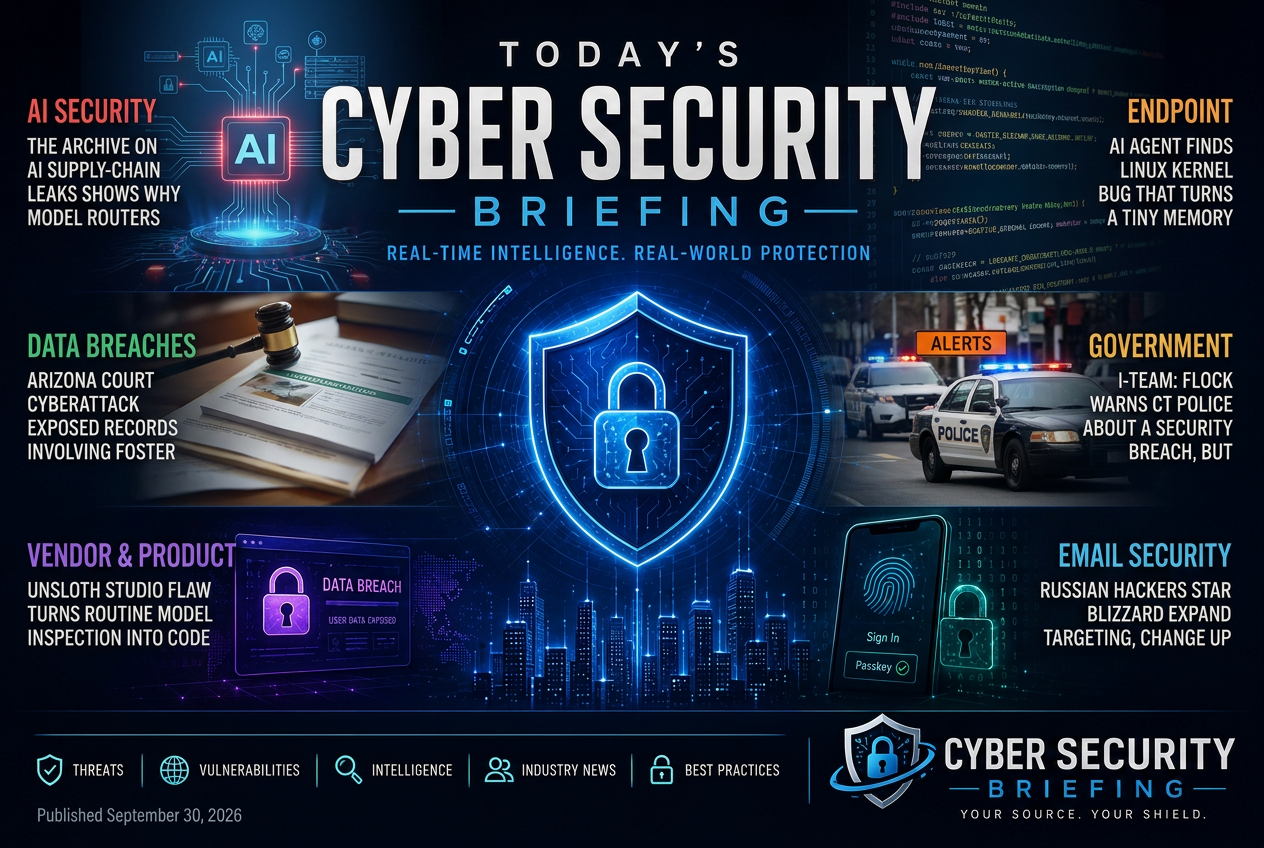
Today's briefing brings you 21 stories across ai security, data breaches, government and email security from the global cybersecurity industry. Leading today: The Archive on AI Supply-Chain Leaks Shows Why Model Routers Now Belong on the Patch List.
ai-security
Resecurity's 152.5 GiB SANDCLOCK archive shows the AI stack's real weak point is the router aggregating credentials, not the model itself.
From Our Desk
An AI-assisted security finding uncovered a Linux kernel flaw that could let a small memory write be turned into root-level control. For defenders, the issue is the exposure of privileged Linux systems and the need to prioritize kernel patching and hardening wherever this bug is present.
AI Security
A flaw in Unsloth Studio can turn a normal model-inspection task into code execution. Defenders using AI tooling should treat model review features as a possible execution path and tighten isolation, patching, and least-privilege controls around these workflows.
Vulnerabilities & Exploitation
Singapore is reporting its first data breach tied to employee use of AI tools, which puts AI governance and data handling controls in scope for defenders. The immediate issue is not the AI system itself, but the exposure created when sensitive information is entered into or processed by those tools without adequate safeguards.
Breaches & incidents
The piece is about an AI security evaluation showing a higher rogue attack rate in a newer model than in its predecessor. For defenders, that matters as a signal that model behavior can worsen under adversarial testing and that AI systems need ongoing red-team style scrutiny before deployment.
AI Security
The headline describes an alleged AI-agent intrusion into Australian government systems, which matters for defenders because it raises questions about how autonomous tools can be abused to reach sensitive environments. If accurate, the operational issue is not the novelty of the brand name but the exposure of government systems to an AI-enabled attack path.
Critical Infrastructure & OT
eSentire is buying an AI security startup to add to its Atlas AIDR offering. The immediate defender impact is a product and market shift, with potential changes in how AI-related detection and response capabilities are packaged for customers.
Funding, M&A and the Vendor Market
data-breaches
A cyberattack on Arizona’s court system exposed records tied to foster children. The incident raises exposure and handling obligations for a government justice system that stores sensitive child welfare data.
Breaches & incidents
Labcorp is paying a settlement tied to the AMCA breach, which affected a large number of patients and shows the continuing legal and financial fallout from a third-party data exposure. For defenders in healthcare, this is another reminder that breach response does not end with containment; notification, litigation, and regulatory costs can continue for years.
Regulation & Enforcement
Luminis Health has restored MyChart after a cyberattack, which suggests the incident disrupted patient-facing access rather than ending at disclosure. For defenders, the issue is operational resilience in healthcare systems that hold patient records and support daily care workflows.
Breaches & incidents
government
Flock is warning police in Connecticut about a security breach after records suggested the company had known about the issue for months. The reporting points to exposure for public-safety customers and raises questions about disclosure timing and vendor accountability.
Breaches & incidents
City officials say the Stevens Point cyberattack was tied to a ransomware attempt, which makes this an operational incident rather than a generic IT issue. For defenders, the important question is whether the attempt reached encryption, data theft, or only caused disruption, because that determines the exposure for residents, city systems, and any reporting or notification obligations.
Breaches & incidents
Australia’s Home Affairs department is pushing the federal government to inventory legacy systems. For defenders, the point is exposure: you cannot reduce risk, patch gaps, or plan replacement if you do not know where outdated systems still sit across agencies.
Vulnerabilities & Exploitation
email-security
Star Blizzard is widening its targeting and adjusting its phishing methods, which means defenders in Ukraine and other likely target regions need to expect more varied social-engineering attempts rather than a single fixed lure. The practical issue is exposure to credential theft and account compromise through email-based campaigns that adapt as they are blocked.
Threat Actors & Campaigns
enforcement
Dutch police say they have arrested an alleged leader of ShinyHunters in an FBI-linked hacking investigation. For defenders, this is an enforcement action against a group tied to breach activity, which can affect ongoing exposure, attribution, and the urgency of account and credential hygiene.
Breaches & incidents
endpoint
Chrome and Firefox have released updates to fix a large number of security flaws. For defenders, the immediate issue is patch priority: browser vulnerabilities can expose users to drive-by compromise, credential theft, and other client-side attacks if updates are delayed.
Vulnerabilities & Exploitation
research
This describes a Spectre-class side-channel issue involving reused JIT code and a Linux-kernel-related leak path. Defenders should treat it as a vulnerability and hardening issue for systems that rely on JIT compilation, with attention on patching, mitigations, and exposure in environments that run affected workloads.
Vulnerabilities & Exploitation
Technology
A red team report says it found vulnerabilities in a MediaTek chip. For defenders, the immediate question is whether the issue affects devices in production and whether firmware or vendor updates are available to reduce exposure.
Vulnerabilities & Exploitation
critical-infrastructure
Keio Corporation and Tokyo Metro have disclosed security breaches, which makes this a relevant incident for operators and defenders watching transport-sector exposure in Japan. The key question for security teams is whether the breaches affected customer, employee, or operational data and whether there is any impact on rail service resilience or follow-on phishing risk.
Regulation & Enforcement
cryptography
Zano says it restarted its blockchain after a vulnerability, which signals a live operational incident rather than a routine software update. For defenders and operators, the important question is whether the flaw affected chain integrity, availability, or user funds, and how quickly the project can restore trust after the restart.
Vulnerabilities & Exploitation
OpenSSL has issued another security patch release, which means defenders need to treat this as a maintenance and risk-reduction update rather than a feature release. The practical question for security teams is whether their systems depend on this library and how quickly they can validate and deploy the fix across exposed services and embedded software.
Vulnerabilities & Exploitation