
Cyber Security Briefing Briefing — November 5, 2026
Thursday, November 5, 2026
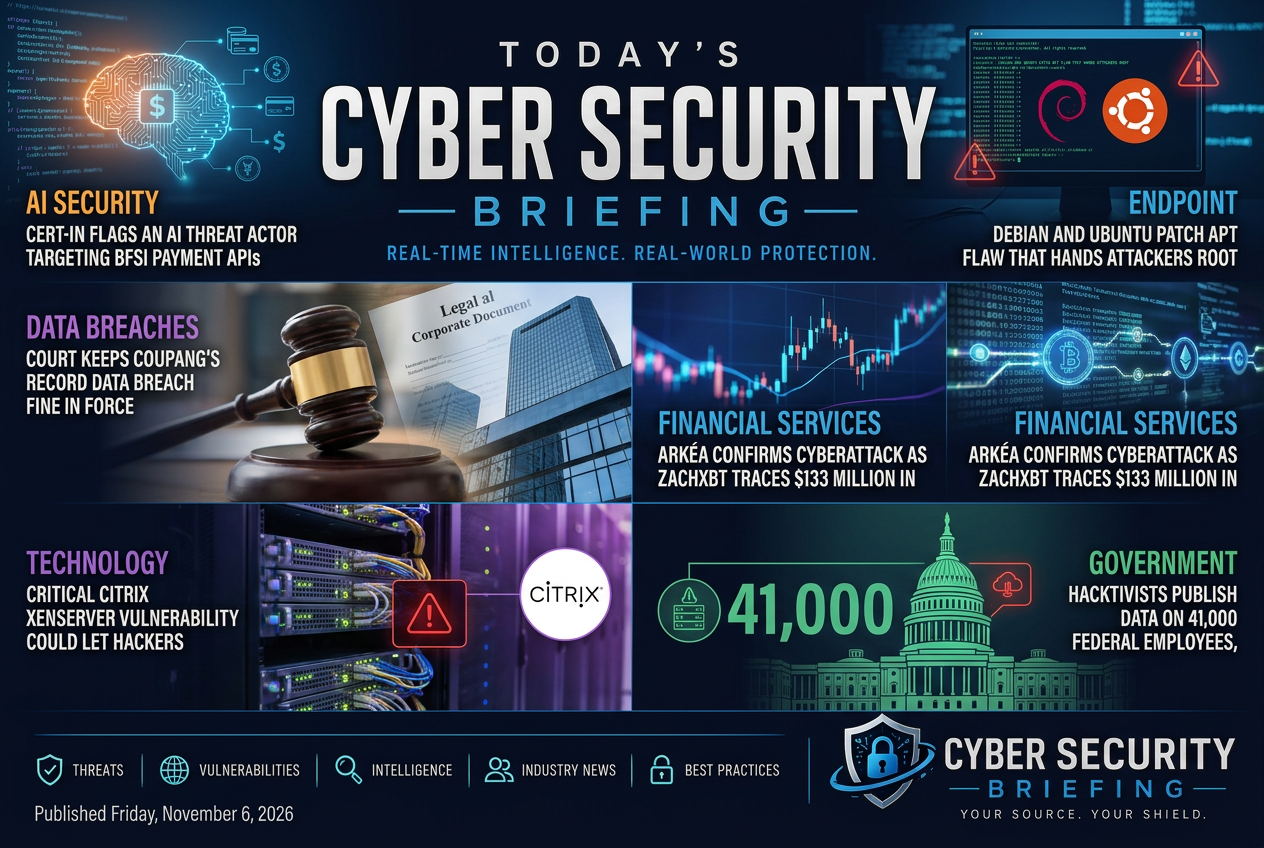
Today's briefing brings you 10 stories across ai security, endpoint, data breaches and financial services from the global cybersecurity industry. Leading today: CERT-In flags an AI threat actor targeting BFSI payment APIs for unauthorized fund transfers - MediaNama.
ai-security
CERT-In is warning that an AI-enabled threat actor is going after payment APIs used in the BFSI sector to try to move money without authorization. For defenders, the immediate issue is exposure at transaction interfaces and the need to tighten API authentication, authorization, monitoring, and anomaly detection around payment flows.
Threat Actors & Campaigns
The piece appears to be about a policy push to extend CISA 2015 for a longer term, with the argument framed around AI-driven exploitation of vulnerabilities. For defenders, the issue is regulatory obligation and longer-term information-sharing expectations, not a new technical exploit detail.
Vulnerabilities & Exploitation
endpoint
Debian and Ubuntu have patched a flaw in APT that could let an attacker gain root privileges on affected systems. For defenders, this is a high-priority patching and exposure-management issue because it affects core package-management software used to maintain Linux hosts.
Vulnerabilities & Exploitation
data-breaches
The court has upheld a record fine tied to Coupang's data breach, so the consequence for defenders is regulatory and financial, not just reputational. The story matters for Korean companies handling customer data because it shows enforcement can survive appeal and remain a real cost of weak breach handling.
Regulation & Enforcement
This is a downstream exposure story, not just a breach headline. The security issue is the release of personal data on a large group of federal employees, which raises follow-on risk for impersonation, targeting, and operational security for agencies and staff.
Breaches & incidents
Jefferson County Public Schools says a data breach may have exposed information tied to more than 37,000 current and former employees. The main defender takeaway is exposure management: affected staff may need notice, account monitoring, and steps to limit follow-on identity abuse.
Breaches & incidents
financial-services
Arkéa says it was hit by a cyberattack, and the reporting ties that incident to large crypto withdrawals being tracked on-chain. For defenders, this is a bank-facing incident with both operational and fraud implications, because it suggests unauthorized movement of funds and a need to review account controls, transaction monitoring, and incident response around payment flows.
Breaches & incidents
Technology
A critical Citrix XenServer flaw could let an attacker take control of virtualization hosts. For defenders, the immediate issue is exposure of hypervisor infrastructure that may support many downstream workloads, so patching and mitigation would be a priority wherever XenServer is in use.
Vulnerabilities & Exploitation
critical-infrastructure
ESET is describing a cyberespionage campaign aimed at Ukrainian government bodies, the defense sector, and a transportation target. For defenders, the main takeaway is increased exposure for public-sector and critical-infrastructure networks in Ukraine, with attention on detection, hardening, and incident response rather than broad policy change.
Threat Actors & Campaigns
application-security
Researchers say flaws in Tata Motors' iRA app could let an attacker impersonate a car owner and use connected-vehicle services without authorization. The issue affects account access and vehicle-control functions, so the main defender concern is account takeover and abuse of telematics services rather than a broad infrastructure impact.
Vulnerabilities & Exploitation