CISA's 2026 Election Plan Names Vendors as Insiders. The Controls It Wants Weren't in Prior Cycles.
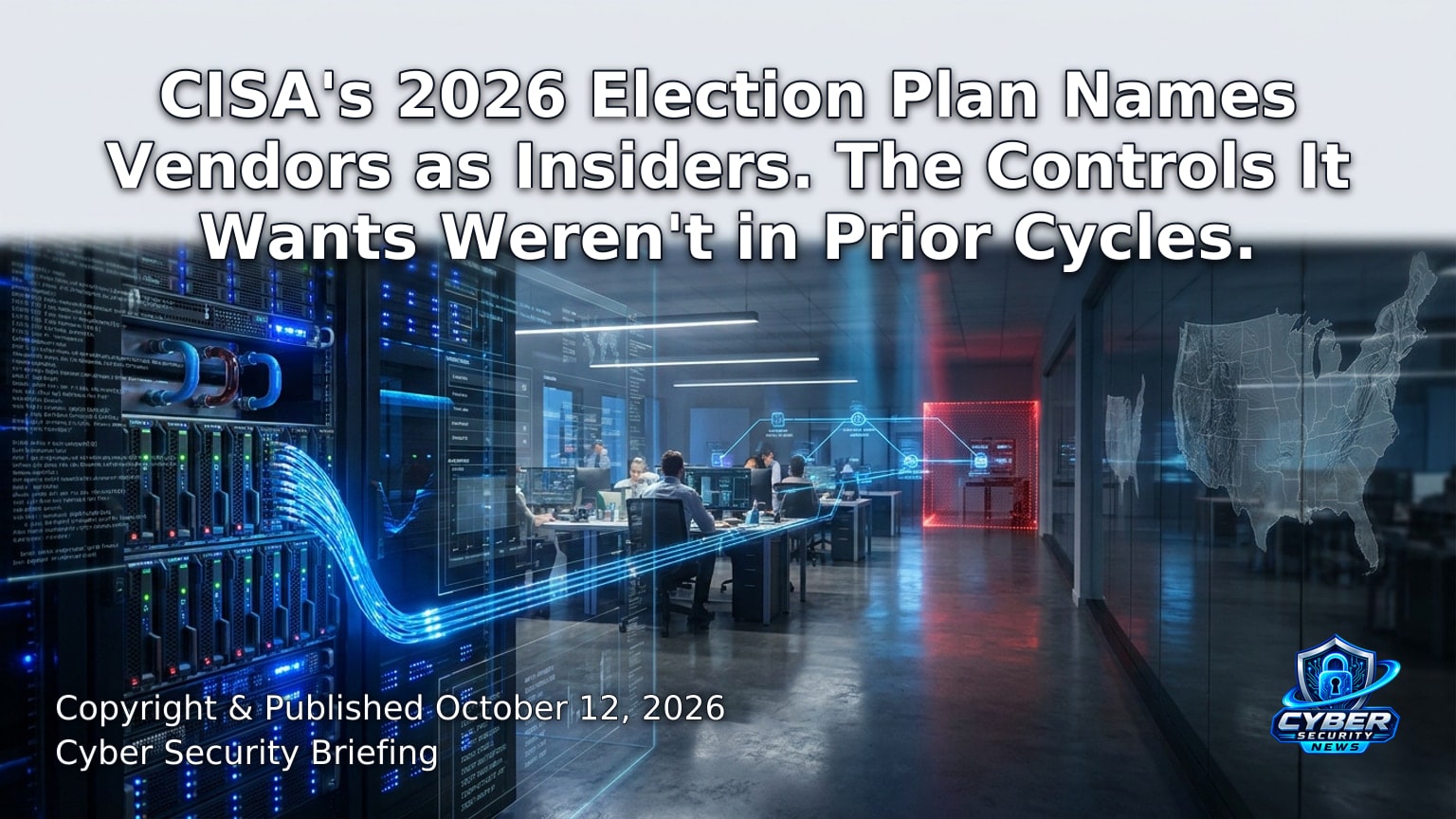
Original illustration created for Cyber Security Briefing.

CISA's 2026 Election Infrastructure Security Plan, released September 24, draws a line prior cycles did not draw explicitly: contractors and vendors are "third-party insiders" whose access "extends the trust boundary beyond the election office." The same document states that hackers have attempted to breach voter registration systems in all 50 states, with confirmed success in at least 20 — a figure CISA does not tie to a single election cycle. Infosecurity Magazine's September 25 reporting frames the same number as accumulated "over the last decade."
Those two facts sit in the same release for a reason. The plan is not treating vendor access as a procurement detail. It is treating it as the attack surface the confirmed breaches came through.
What the plan actually names
The document, titled "Securing the Next 250," was announced, according to the Department of Homeland Security's September 24 announcement of the release. DHS's framing stresses that CISA has returned to its "core mission to protect critical infrastructure."
The plan itself goes further than the announcement. It specifies controls: role-based least-privileged access, phishing-resistant MFA for privileged accounts, and comprehensive logging with critical logs retained for at least one year, per the CISA text published the same day. None of that is unusual for a large enterprise. What is unusual is seeing it written into a federal election-security document as a direct response to vendor risk rather than general hygiene.
The 20-state figure, twice
CISA's companion document, "Recognizing and Addressing Threats to Statewide Voter Registration Databases," repeats the all-50/confirmed-20 figure and adds a historical detail: "recently declassified records revealed that China breached multiple state voter registration systems prior to the 2020 election." CISA does not say which records or when they were declassified. Infosecurity Magazine's September 25 coverage, separately, describes the 20 confirmed successes as a tally "over the last decade," which changes the figure from a single-cycle alarm into a baseline rate.
That distinction matters for how a CISO reads the statistic. A one-cycle spike argues for emergency controls. A decade-long baseline argues for the plan's actual prescription: architectural separation of public-facing services from the master database, so that online functions "never interact directly with the system of record," as the CISA voter-database document puts it.
Insider guidance, three weeks earlier
CISA had already revised its baseline insider-threat guidance before the election plan shipped. The Insider Threat Mitigation Guide, 2026 Edition, published September 9, explicitly covers "third-party threats created by contractors and vendors with elevated access privileges." Acting Executive Assistant Director Scott Breor said the update addresses "evolving considerations such as the rise in hybrid and remote work, and advances in artificial intelligence."
The patching problem the plan admits is unsolved
Vendor access is not the only vendor problem CISA flagged. SecurityWeek's September 25 analysis highlights the agency's concern that "structural constraints within the certification ecosystem can significantly limit vendors' ability to release patches." Election infrastructure is often reachable from general enterprise networks, the outlet reports, which lets an attacker who gets a foothold move laterally into systems the certification regime was supposed to isolate.
CISA's own fix is to align patch management with certification requirements so updates can be applied in real time without decertifying a system. Certification bodies, not CISA, control the timeline for requalifying a patched system, and the plan does not claim authority over that process. WebPulse's September 27 coverage puts the tension plainly: a compliance regime built to lock down configurations can "lock out the fix for a known flaw."
What CISA is asking vendors to adopt
The same WebPulse piece reports that CISA is pushing election officials to hold vendors to standards "long common in corporate IT departments" — CVE tracking and a software bill of materials. That gives election offices a lever they didn't have in prior guidance: a documented list of what's running, not just an assurance that it's certified.
Infosecurity Magazine's reporting adds a practical detail for anyone managing privileged accounts in this environment: officials should implement phishing-resistant authentication "where possible," a qualifier that acknowledges legacy systems where it isn't. The outlet also notes CISA's Election Security Risk Profile Tool, developed jointly with the Election Assistance Commission, as the mechanism officials are meant to use to assess where vendor access sits relative to the master database.
Where the legal gap sits
Industry commentary published on the Votem blog September 26 makes a point worth sitting with: "a vendor's security controls do not settle legal questions" about statutory election procedures. Votem is an election-technology vendor, and its advice — map "third-party handoffs" and "undocumented dependencies," establish who owns critical work before voting opens — is also the minimum a vendor needs its customers to believe is sufficient. It falls well short of the plan's own prescription of architectural separation.
Still, it is an ask a CISO managing an election-adjacent contract can execute without waiting on a certifying body. A vendor contract that doesn't specify log retention, incident evidence ownership, or which party controls patch timing leaves exactly the ambiguity the plan is trying to close.
What this means for anyone outside elections
None of the plan's specific controls are novel to security engineering. Role-based access, phishing-resistant MFA, SBOMs, year-long log retention — these are baseline asks in most mature supply-chain programs already. What's notable is that a federal critical-infrastructure authority has written vendor access into a sector plan as the primary insider-risk category, ahead of insider risk from employees themselves.
Links Verified at Time of Publish.
Sources
This article was reported from the following sources.
- 2026 Election Infrastructure Security Plan — Cybersecurity and Infrastructure Security Agency (CISA), 2026-09-24
- DHS Announces Release of 2026 Election Infrastructure Security Plan — U.S. Department of Homeland Security (DHS), 2026-09-24
- CISA Election Security Plan Flags Patching Barriers, Voter Database Attacks — SecurityWeek, 2026-09-25
- Recognizing and Addressing Threats to Statewide Voter Registration Databases — Cybersecurity and Infrastructure Security Agency (CISA), 2026-09-24
- Insider Threat Mitigation Guide: 2026 Edition — Cybersecurity and Infrastructure Security Agency (CISA), 2026-09-09
- CISA 2026 Election Security Plan: Eight Questions to Ask — Votem Blog, 2026-09-26
- CISA Unveils Election Security Plan Ahead of 2026 Midterms — Infosecurity Magazine, 2026-09-25
- Mitigating Insider Threats to U.S. Election Systems — IC3 (Joint DHS/CISA/FBI/EAC Publication), 2026-10-01
- CISA Election Security Plan Flags Patching Barriers, Voter Database Risk — WebPulse, 2026-09-27